
Standing Above The Clouds
9/10/2026 | 55m 35sVideo has Closed Captions
Native Hawaiian mother-daughter activists stand to protect their sacred Mauna Kea.
When a massive thirty meter telescope is proposed to be built on Mauna Kea, kiaʻi (protectors) in Hawaiʻi and around the world dedicate their lives to protecting the sacred mountain from further destruction. Through the lenses of mothers and daughters from three Native Hawaiian families, the film explores intergenerational healing and the impacts of safeguarding cultural tradition.
Problems playing video? | Closed Captioning Feedback
Problems playing video? | Closed Captioning Feedback
Funding provided by the Corporation for Public Broadcasting and the National Endowment for the Arts.
Standing Above The Clouds
9/10/2026 | 55m 35sVideo has Closed Captions
When a massive thirty meter telescope is proposed to be built on Mauna Kea, kiaʻi (protectors) in Hawaiʻi and around the world dedicate their lives to protecting the sacred mountain from further destruction. Through the lenses of mothers and daughters from three Native Hawaiian families, the film explores intergenerational healing and the impacts of safeguarding cultural tradition.
Problems playing video? | Closed Captioning Feedback
Where to Watch Pacific Heartbeat
Pacific Heartbeat is available to stream on pbs.org and the PBS app.
Providing Support for PBS.org
Learn Moreabout PBS online sponsorshipNATIVE: We are all connected.
NATIVE: When the forests disappeared, we lost our homes.
NATIVE: We lost a lot of our cultural practices after colonization.
NATIVE: But now we're trying to get things back.
IWALANI: Through your art form, people will see your humanity.
NATIVE: We will do whatever it takes for the many generations to come.
♪ ♪ (conch shell reverberates).
(conch shell reverberates).
(conch shell reverberates).
(women begin chanting quietly).
♪ ♪ PUA: The ways of our people are connected to sacred places.
(women pray and chant).
And as mothers, it's our kuleana, it's our responsibility to pass on these ways and these practices to our daughters so that they will remember.
And then they'll honor these places that strengthen us.
We pray here.
We sing here.
We chant for the unseen and the unheard.
And rest assured, we will do whatever it takes to protect these ancestral places.
And not just for this generation, but for the many generations to come.
(drumming).
(bird chirp).
♪ ♪ (quiet chanting).
PUA: What initiated my involvement in standing for Mauna Kea was a very special day for me.
And it was years ago.
(chant continues).
My younger daughter said to me, “Mommy, I am seeing someone from our ancestral realm.” (chant continues).
KAPULEI: I think I was about maybe nine when I probably first started just seeing in general.
It's your kupuna, it's your ancestors and your guides who are trying to reach out and just either give you a message or let you know that like they're here and they're here to help you.
(conch shell reverberates).
I saw the guardian of this lake, Mo'oinanea.
(water flows gently).
She asked me.
Can you try again?
Can you try and stop it?
♪ ♪ PUA: I'll never forget her exact words.
The lady said, if you can try one more time, because I didn't know what she was talking about.
So I said, uh “Try one more time for what?” And she said “To stop the telescope, Mom.
Can you try one more time to stop the telescope?” And my fear went to what about my job?
What about my safety?
Or what if I stand alone?
I went into perhaps the biggest fear.
I knew that my family would be involved, and I knew that our lives were gonna change.
♪ ♪ REPORTER: Another major development is about to take place atop Mauna Kea.
REPORTER: Many countries including China, Japan, India and Canada are invested in the project that's supposed to be completed by 2024.
REPORTER: It would be one of the largest moving structures ever constructed.
The building will be 18 stories tall.
REPORTER: Scientists say the telescope will help them peer into the deepest corners of space.
But Indigenous resisters say the construction was approved without their consent and will desecrate their sacred lands.
PUA: There's already 13 up on the summit, but this time it was gonna be the one too many, the one too big.
KAPULEI: I see the Mauna every day, literally right from my house.
You can look right out the window and she's right there.
So I know a lot of us in my family, we use that to kinda just like start our days of like, "Oh, there is the Mauna time to address and greet her."
So it's nice to be able to see her and then be able to be like, "Ok, girl, this is like what I'm doing everything for."
♪ ♪ (hums softly).
My papa, my uncle, my mom, everyone have always said that there was always promise that that telescope would be the last one for every single telescope that's up there.
So a lot of empty promises, which is not really surprising and is why we are in the situation we are in now.
♪ ♪ HAWANE: Mauna Kea is our actual ancestor.
We are related to this mountain.
And so we are taught to take care of this place and we take care of our land as we take care of our "ohana," our family, as we take care of our, our elders.
Mauna a Wakea is an elder.
♪ ♪ All of our aquifers on this side of the island is fed by this mountain.
The Mauna calls in the rain and the snow, and that pure water form trickles down into all of our waterways.
And so when the mountain, you know, is calling for us to stand, it was automatic for me to come into the space to listen to my sister and to my mom and to know it's like an innate kuleana.
(chant).
How could we not stand for this?
(soft drumming).
KALANI: So what's coming up... They're gonna have a big... in October 7th groundbreaking on the mountain.
Even though these things are in litigation, they're moving ahead.
Maybe we just have to have enough kanakas to shut the mountain down.
We just trying to protect what's still left, what's still sacred.
(chanting).
HAWANE: You know, this is our first stand.
And especially with this generation, this is our first time!
LANAKILA: Are you Pele?
Can you call forth pahoehoe lava from the core of the earth?
No, you cannot.
So do not destroy what you cannot repair.
NATIVE: You have the approval of some but you don't have the approval of all.
(crosstalk).
NATIVE: A'ole pono, a'ole pono.
LANAKILA: I am not the only voice... HAWANE: This is not your place... NATIVE: A desecration... HAWANE: And this is our piko, our genesis moku.
This is where we come from.
So respect us.
(chanting).
REPORTER: The protesters stayed to make sure no ground would be broken and they helped clean up the empty chairs.
For today, opponents of the project enjoyed a victory.
HAWANE: And I remember it was that moment that put the call out to the entire world that we're gonna do this in a different way.
We're coming heart forward, na'au forward, kupuna forward to our sacred place.
LEINA'ALA: I grew up, you know, in this colonized world that, you know, we live in.
So I didn't realize how connected um, I could be.
My mom would talk to me about having to go to ceremony, I would kind of laugh like, "what's ceremony?"
Like, ok.
And then my mom kind of convinced me to start dancing again.
So then I would go to practice with Aunty Pua and she would talk to us about, you know, what was happening on the Mauna, and what happened with Kapulei and the visions or the messages that she got.
And... that was my life from then.
(chanting).
(chanting continues).
PATRICIA: The places that we grew up in, we can't go there anymore because of somebody coming in and taking it or military or whatever it is.
We need to fight for the kids.
We need to keep it for generations to come.
(birds chirping).
MEHANA: This is like the, the notepad I would use for waitressing and I would have it in my... 'cause I, you know, I'd have to go back and forth to work and go to court.
And so I would have this so I would write my questions down on them.
I would just write it on anything.
And so I have like all of these, you know, all these papers.
Look at this one too, you can't even understand it.
This was Tali, she was nine and this was another one.
“I love Mauna Kea like I love my mama.” So this was a calendar that we made to remember profound moments and some of the highlighted dates here are from April 2nd, 2015.
That was the second TMT stand off, and that was the first day of the actual arrests on Mauna Kea.
So that was 31 arrests that day.
(chanting).
(protesting).
(singing in Hawaiian).
HAWANE: There were moments throughout the day where I was just, whew, what would my mom do?
What would Pua Case do?
She wasn't there with me.
(chanting, drumming continue).
And I was just trying to hold on to some strength.
But I was... I was needing her.
When she finally reached the top, she could see that I was shaken.
So many people that I love were arrested right in front of me.
And she came in chanting... (chanting).
(conch shells rings out).
HAWANE: And I answered her.
(chanting).
(chanting and protesting continue).
HAWANE: She's the call, I'm a response.
And that's us.
She's the one that so many people go to when they're standing on the frontline.
(chanting).
REPORTER: Protesters once again prevent TMT crews from restarting construction of the controversial telescope.
OFFICER: Aunty Pua, you leave Aunty Pua there, she get 'em, this is her kuleana.
OFFICER: I'm not going to keep this courtesy warning... PUA: I wanna know if we are in mid-prayer, will you just arrest us in mid-prayer?
That's all.
OFFICER: Okay, to be fair, you can do your prayer off on the side of shoulder, I'm letting you know that.
I'm not gonna stop you from praying, but you're not gonna do it in the middle of the road to obstruct traffic.
MEHANA: The state intentionally puts our Kanaka police officers on the frontline to arrest us.
PUA: Anyone who heard the warning from down there cannot join another line.
(chanting).
KAPULEI: Once it got chaotic, you just gotta go by like instinct, what like feels right.
(defiant chanting and chaotic chatter).
PROTESTOR: We wanted to finish our chant.
We wanted to finish our chant.
MEHANA: At that moment when the DLNR was at the last line, at line ten, you could just see the mist covering everything.
(conch shells rings out).
That's Lilinoe, she's the goddess of the mist.
(chanting and clapping against bodies).
When the women come together... And call upon these guides... they hear us.
(chanting).
(protesters cheer and whoop in celebration).
PROTESTOR: Chee-hoo!
PROTESTOR: Turn it around!
PROTESTOR: Yeah!
PROTESTOR: Woo hoo!
MEHANA: If you allow this project to proceed, you will be sending the message out, not just to Hawaii, but to the world, to every indigenous nation that Native Hawaiians are less-than, that indigenous people are less-than, that money is more precious than the land and precious natural resources that you vowed to protect.
This case reaches every corner of this earth and hundreds of thousands of Native people are watching your every move.
KALANI: You look at the report, it's hundreds of shrines on this mountain.
All these triangles represent some cultural feature on the mountain.
LAWYER: Were you ever arrested on Mauna Kea?
HAWANE: Yes, on September 9th, 2015.
I was in a circle of women and we were calling on the Gods and Goddesses of the mountain, and we never got to finish that chant because we were ripped apart.
We were pulled apart right in the middle of it.
PROTESTOR: Why do I need to put my hands behind my back?
OFFICER: Because you're getting placed under restraints, ma'am.
(chanting continues).
LEINA'ALA: I have been arrested twice and I can personally speak to the violence and trauma it has inflicted on me.
It had adverse impacts and has been detrimental not only to my health, safety and welfare, but to my 'ohana as well, as they have gone through the emotional, psychological, as well as financial struggles right along with me.
(indistinct chatter).
Being and living this life that we live, especially on the home front.
I had to learn balance.
Being in the court hearings, even being on the Mauna for a month and not having income is really I mean, for me, it's rough.
WOMAN: So are, are the bags packed like last time?
WOMAN: Yeah, I get that.
WOMAN: This time will be a bag, you know, but I'm trying to... KAHAILI: I just really love Mauna Kea.
I don't want anything to happen.
Anything bad.
Like if I'm stressed, my mom takes me up there and... I just, I feel better when I'm up there.
(indistinct conversation).
(traffic noise, honking).
PUA: When I think about all the things that make us tired and exhausted and might get us down, I say we must remain in good spirits.
We must remain positive.
FILMMAKER: You know, when your mom says she hasn't taken a day off in ten years?
(laughter).
How do you feel about that?
KAPULEI: I feel like that is extremely 100% accurate.
(chuckles).
Like no exaggeration.
FILMMAKER: And when you see her work that hard, how does it make you feel about like your activism and how you wanna do things?
KAPULEI: Well, I definitely know that I do not want to be the kind that never has a break like that, because that is... I, I don't understand how she does that.
It is insane like, that woman does not like stop.
Like her rest is still like she's doing some other form of working.
It's just not as, like, either laborious or not as bad, but she's still, like doing something, you know?
So it's not actually resting.
Yeah, I definitely wanna be one that doesn't take on as much.
I only will take on as much as I can handle.
♪ ♪ A lot of things we do, it's like you don't really have a choice, you know, like it's like something you should do or have to do, but like, you don't really have a choice.
♪ ♪ Just trying to look at it like for what it really is and be like, yeah, like if we don't do this then like no one else might, so... if it's our responsibility, it's our responsibility.
♪ ♪ What our people are still facing today has been going on for generations.
PUHIPAU: This is how you treat Hawaiians, ladies and gentlemen.
Put em in jail, knock down their homes, kill their culture, and eliminate the Hawaiian race.
(chaotic yelling).
(screaming).
OFFICER: We're going to ask you to remove yourselves and your belongings back beyond the perimeter line, which is the road or the beach.
CHILD: We not gon' live on the streets!
We no more house!
CHILD: Yeah!
CHILD: At least give us a piece of land for live on!
CHILD: Yeah?
IPO: We don't go to your grave sites and dig up your families and take your jewelry and take all your possessions and put them in your museums to show the tourists.
HAUNANI-KAY: They took our land.
They imprisoned our queen.
They banned our language.
They forcibly made us a colony of the United States.
SOLDIER: Fire!
(explosive shot).
GEORGE: Because in Hawaiian thinking, see, life comes from the womb, Mother Earth.
She is not a barren rock that should be used as a target for military bombing practices in the name of national defense.
The strength of our national defense lies in the spirit of the people.
Aloha Aina, we love the land.
♪ ♪ IGE: Yesterday afternoon the Department of Land and Natural Resources issued a notice to proceed to the University of Hawaii at Hilo for the Thirty Meter Telescope.
Since the notice to proceed has been issued, we expect the TMT construction to begin sometime this summer.
♪ ♪ (chanting in Hawaiian).
(chanting in Hawaiian).
(chanting continues in Hawaiian).
(chanting continues in Hawaiian).
(chanting continues in Hawaiian).
(chanting continues in Hawaiian).
(chanting continues in Hawaiian).
(indistinct chatter).
(conch shell reverberates).
PUA: This right here on this access road across of a parking lot in a lava field is the way that we stay fully committed to why we are here.
And our reason for being here, you may have your own personal reason, but our collective reason has always has been stopping the building of an 18 story telescope in a pristine area near the summit of our Mauna, on a fragile ecosystem that is full of our kupuna, our cultural ways, and our rights to our water, and our future.
(sniffing).
HAWANE: For me, I have to bring in as much as I possibly can that I do in my normal life when I'm not on the stand, because that makes me feel pa'a and strong.
And most of all, it makes me feel ready.
(faint chatter).
LEINA'ALA: For me, it's mostly just getting myself ready spiritually, emotionally, all that kind of stuff.
So that's how I try to prepare myself and fortify myself is to just like put that shield of prayer on and ask my ancestors for guidance.
(thunder rumbles).
MEHANA: Do I have to lift my finger up?
MEDIC: No, relax, boo, relax.
(gasps).
96!
MEHANA: Is that good?
MEDIC: That is excellent!
Especially for this altitude.
MEHANA: Yeah!
MEDIC: 92 is ok but 96 is very good!
(quiet chatter).
MAN: Breathing.
MEHANA: Breathing.
KAHO'OKAHI: Whether you come today, whether you come tomorrow, whether you come next week or next year, whenever it is, as long as our Mauna is threatened with desecration through the building of the Thirty Meter Telescope, we will be here.
CROWD: Eo!
KAPULEI: Our moments in the van are like our closest moments we've had... PUA: Mm-hm.
KAPULEI: In like a while, 'cause I don't see her a lot during the day 'cause she's doing 1,000 things 'cause she's Pua Case.
(laughs).
PUA: Mm-hm.
KAPULEI: But yeah, it's like our little sanctuary in here.
A few... PUA: Mm-hm.
KAPULEI: It's like rest moments where we can just hide.
PUA: Yeah.
KAPULEI: From all the things going on outside here.
PUA: Before we can make any decision or move or interact, be it with the military or the armed forces or even each other, in the words of the chants and the vibration of the chants, are requests to our ancestors.
And those requests call upon them all.
And if you call upon them, you better be ready to get an answer, because they come running.
And we get a little faster so we can get all the way up to the Mauna.
Just in case we have to walk up.
We gonna hula up.
There you go.
(chatter and laughter).
(speaking in Hawaiian).
(group claps and singing in Hawaiian).
(conch shell reverberates).
HAWANE: I've had scary movie dreams, probably because the Pu goes off... (laughter).
And the Pu reminds me of 2:00 a.m.
in the morning.
Run!
And everybody is running across the road.
(conch shells reverberate).
(conch shell reverberates).
REPORTER: Hundreds have gathered at the base of Mauna Kea Access Road.
Roughly eight or nine people have chained themselves to a grate in the road.
♪ ♪ (drumming).
(indistinct police chatter).
OFFICER: Why don't you just move 'em after... OFFICER: Yeah, yeah.
MAXINE: Your grandmother and my grandmother probably knew each other.
And probably I know all your family.
How?
How can you be so cold hearted?
Look what we have to do to hold our 'aina!
(crying).
(speaking in Hawaiian).
The leaf of love, I give to all you folks.
E honi!
Please, go home.
Leave us alone today.
Please, do not arrest them to protecting the desecration of our land.
Where's your folks heart?
(crying).
Where's your folks heart?
Please.
You arrest them, you arrest me!
Arrest the kupuna!
REPORTER: I wanted to show you the two tents behind me.
That is basically the barricade or checkpoint that the activists had set up, that's the kupuna line.
PUA: Being in this movement and being, putting yourself in harm's way is one thing.
But when you're having to make plans with your own children on what happens if the police come.
REPORTER: Dozens of Honolulu police officers arrived on the big Island to support law enforcement efforts.
PUA: I'm thinking of securing my girls and then running over and helping to secure the whole lahui.
PROTESTOR: Today, we're gonna continue to be here.
Our kupuna have made their position very clear.
And for those of us who are not in that position, it is our kuleana, our duty and our... our sacrifice... to allow them to do that, to stand on the side and to watch our kupuna perhaps be taken away.
HAWANE: We have hundreds... hundreds of kia'i flanking the road.
And our kupuna again, are holding strong on the front line.
♪ GROUP: Oh no you will never find ♪ ♪ another kanaka like us... ♪ HAWANE: And this is how the kupuna prepare, in song.
PUA: Ok, everybody off to the sides, everybody sitting, everybody hamau ka leo, everyone honoring the kupuna, this is their day.
Mahalo nui, lahui.
Mahalo nui.
OFFICER: I respect you guys, I really do.
Today we need to get the road open.
We need to.
PROTESTERS: Eo!
Eo!
PUA: This is the moment our kupuna are going to remember forever and so will we.
(quiet sobs).
PROTESTOR: Mahalo.
Mahalo.
PROTESTORS: Eo!
(protesters cry out).
PROTESTOR: Aloha Aina!
(protesters cry out).
(clapping, chanting).
PUA: Kapu Aloha.
Move back.
Mahalo.
ELDER: Unity, Hawaiians, unity!
Rise up.
Unity.
The mountain will bring us together.
(protestors chanting).
(protestors chanting).
(conch shell reverberating).
MAXINE: Stand for the Mauna now.
Don't leave the Mauna.
(door slams shut).
REPORTER: Over two dozen kupuna and their caregivers arrested on the mountain.
During the arrests of the kupuna, others would occupy their seat.
(protestors chanting and crying out).
OFFICER: You're creating a dangerous situation.
We need to keep the roadway open for vehicles to pass.
There are orders to immediately move off of the highway.
REPORTER: A blockade of more than 100 protesters formed with women in the front.
The major said police were outnumbered ten to one by 2,000 demonstrators.
(conch shell reverberating).
♪ E Aloha e!
♪ ♪ E Aloha e!
♪ ♪ E Aloha e!
♪ ♪ E Aloha e!
♪ HAWANE: Officers coming down.
♪ E Aloha e!
♪ ♪ E Aloha e!
♪ ♪ E Aloha e!
♪ ♪ E Aloha e!
♪ (cheering).
(crosstalk, loud chatter).
HAWANE: Aloha mai kakou!
Mahalo again, for holding this beautiful space.
The Mauna is safe today.
Eo.
♪ ♪ (chanting).
(speaking in Hawaiian).
(cheering).
(chanting).
(chanting).
(clapping).
(chanting).
GOODMAN: Even more demonstrators gathered at the access road to thwart construction.
Can you talk about the other solidarity actions that are taking place?
PUA: People in the Pacific, our Polynesian relatives, and people around the world are standing for us everywhere.
(chanting in Hawaiian).
LADONNA: The Mauna can heal the people.
You can feel the healing that comes right out of the ground here.
It is not about fighting something.
It is about loving something, so passionate, so much connection.
Why are you standing here?
Because we must heal as a people.
We must heal.
And we know that way deep down inside of us, we must protect the healing.
REPORTER: It's Day 63 and the kia'i or protectors have been blocking Mauna Kea Access Road since July 15th.
OFFICER: Crossing!
REPORTER: The kia'i remain resolute in their desire to stop TMT from reaching the summit of Mauna Kea.
(indistinct chatter).
SERVER: Ok I'm gonna put em right under here... Ok, thank you, thank you.
(speaking in Hawaiian).
PUALANI: ...About how the Pele migration came down from the North, and they landed on all of these islands.
HAWANE: One, two, one, two, three.
One, two.
One more time.
One, two, three.
One, two... (chanting in Hawaiian).
I always say that we can heal through this work, and we don't just have to heal from it.
It's no joke, it is the frontline.
It's not a party.
It's not always fun.
It's real.
The kupuna are sitting in the actual roadway for a reason.
(distant singing).
ANDRE: Two things I want to remind folks, for nighttime, we find that it's very unlikely they would come at night but it would not be the first time if they did.
So It's important that we want to malama our kupuna and know that, you know, we need to get here to hold this space.
(chanting).
(chanting continues).
ANDRE: Without placing an unwanted burden, we would like to offer these ki'i, these gifts to, to kahu who, if they want to, to care for them then it is theirs to care for.
And we would like to offer this Wahine Noho Kapu, Wahine Noho Mauna, this representation of all the feminine elemental energies upon the Mauna to Aunty Pua Case and her daughters with an emphasis that Kapulei will be the long term steward of this ki'i.
(chanting).
(chanting).
(chanting continues).
(chanting continues).
(chanting continues).
(chanting continues).
REPORTER: The kupuna are determined to fight the charges.
And their attorneys say even though they were arrested together on Mauna Kea, on the same day, they're expecting to have individual trials that are not lumped together.
One by one the kupuna.
MEHANA: What happens is gonna affect, like so many different countries, and movements, and nations in the way they move forward to... to protect their lands.
FILMMAKER: Yeah.
MEHANA: And I think that's what's most like scary to like the state and to all these corporations is just like how we proceed is gonna determine, you know, so many other different movements.
And if we're successful, which we are, you know, which we already are, like how much loss they're gonna experience, you know.
(cooing, laughing).
(speaking in Hawaiian).
(laughing).
(street noise).
PUA: I knew that something was not right with my own health that I had ignored from on the Mauna.
“I'll take care of it when we come down the mountain.” "I'll take care of it when I have time."
And those are the real front lines.
When you face your own mortality, the breakdown of your body.
I know I'd rather be on the Mauna uh, facing anything else but that.
(Hawaiian music playing on radio).
(Hawaiian music playing on radio).
(Hawaiian music playing on radio).
HAWANE: I wanna see my mom.
Like I mean have we addressed this or talked about this to any like Mauna people, because, like, people probably have PTSD from being on the Mauna.
PUA: When they contact me personally, because I don't know that, then... HAWANE: I think we should put resources, I think we should put, well, maybe I'll look of resources of how like somebody to call if you have an anxiety attack or an encounter with the police because it's really real for me, because plenty of people probably have this in any encounter with the police after standing on the front line like that.
PUA: Mm-hm, yes, that's very true.
So this was all from my anxiety attacks this past two weeks.
HAWANE: Why did you have an anxiety attack?
PUA: Because I couldn't breathe.
I laid it all out so we can see how difficult it is for me the past two weeks for Leina'ala, for Lan, for whoever.
You know this kind of healing is why you go to a retreat, you know, but retreat is a kitchen table for some of us, right?
So, you know, it is what it is.
(door shuts).
RADIO REPORTER: Most of the kupuna want their day in court and to ultimately settle legal issues surrounding the mountain.
A petty misdemeanor, punishable by up to 30 days in jail, and $1,000 fine.
REPORTER: After nearly 120 days deadlines for prosecution are coming up fast and set for trial December 20th.
HAWANE: I don't think I'm ever gonna get over watching them get arrested.
Like it still hurts my heart thinking about that.
Even though so many of them said, "Don't worry about it, like this is what we're gonna do, this is what we do.
Like, how can you get over that?
You can't ever get over watching your own elders arrested.
Like... Like, it takes time.
It takes... space.
KAPULEI: For me it's just kind of understanding my place and kind of like my role in it all.
And like... (crying).
When I got up there, it was like hard.
I didn't really have anybody.
I didn't really know anybody.
And like I was by myself a lot.
Had to take care of myself a lot.
And just kind of being my own pillar for a lot of it.
Um, I didn't really have anybody like to be with, so I feel like that is my biggest learning, I guess, is learning how to keep myself safe because I know it's probably gonna be like that for a long time, where I'm not gonna have anybody because everyone's busy doing something else.
HAWANE: I don't want you to think that you have to do it on your own, Shu.
KAPULEI: But I always am and I understand why.
Like it's not a type of situation to burden anyone with yourself when they're already dealing with so much.
HAWANE: Like, I promise to be more supportive and check-in more and do whatever I can to help you feel safer.
Anything that I can do to help you feel more held in what you're going through, I'm here.
You don't have to do everything alone, and you don't have to always be strong, you can talk to me.
(ocean waves lapping).
REPORTER: All this week, opponents have been speaking out at hearings held by the National Science Foundation.
The agency is accepting public comments as it conducts an environmental review on the stalled Mauna Kea project.
LEINA'ALA: My name is Jennifer Leina'ala Sleightholm.
And in 2015, I was up on the Mauna with my then 8 year old daughter and my nine year old son, and my mother... and I say it 'til today that that was a time where I think my kids were their happiest.
They were engaged, they were connected, they were seen and they were the most authentic I think I've ever seen them before.
And then on September 18th of last year, my daughter committed suicide.
And that was the 8 year old little happy girl that was the Mauna just a few years before that.
And I bring that up because the state of the world that our children are growing up in, we need to do everything we can to protect these spaces that we have left for them, so that they can return there and reconnect.
And it's so important that we speak up now, now is not a time where you just sit idly by and like... we've been through the contested case hearings and been arrested on the Mauna, and it's just kind of traumatic for me, not only because of my daughter, but coming here over and over and over again... (crying).
Saying the same thing.
But I have to be her voice now because she's not here.
And to make sure that when she stood there it mattered, and she mattered.
(Leina'ala chants).
And my desire and I wish for my children and grandchildren and the next generations to come is that it stops with me.
(singing softly in Hawaiian).
HAWANE: And so, you know, when we were getting together and thinking about what to gift you and for the memory and the life of Kahaili.
And so we want to present this to you.
We love you so much Tita.
We love you, you are our sister, you are our friend, and we got you.
And this is also our commitment to say that we have your back through every phase.
And it's a safe place for you to come to any time that you need, any time that you need.
LEINA'ALA: It's so beautiful.
HAWANE: It's so beautiful and... LEINA'ALA: So grateful.
HAWANE: Yeah.
LEINA'ALA: That's so Tita.
HAWANE: Isn't it?
LEINA'ALA: Yeah.
(laughing).
HAWANE: Yes.
LEINA'ALA: Mahalo to all of you guys.
-Yes.
HAWANE: Just turn it over.
KAPULEI: Right yeah, 'cause the triangle is right here.
PUA: Ok, so gotta turn over.
(quiet chatter).
HAWANE: I think any family that is in a movement, especially an Indigenous/Native movement, understands how much of a toll that can take on a family.
It has shown us all aspects of each other.
It has shown us the vulnerable sides of each other, the strong sides of each other, the sides we maybe never would have seen of each other.
And I think what I found through this movement is understanding that we're all going through this movement together and we're all going through our individual things as well at the same time.
So to truly have understanding and compassion for each other, I think it's helped us better communicate and be able to rely on each other.
(birds sing and chirp).
(birds sing and chirp).
Okay, let's go in a little circle.
Hhaahhh, Lonoikamakahiki is everywhere.
We can feel it on our skin as we look at these Mauna.
Calling in Kahaili and our tita Leina'ala.
So when we chant, let's chant for them too today and lift them up too.
I know that this is the first time for some of you being back here to Pu'uhuluhulu since the stand.
It's an opportunity for us to create an evolved relationship with this place and with our memories of this Mauna.
We all have something that we're healing from here, and that's okay.
And it's also okay to let that go.
♪ ♪ PUA: I've learned from both my girls and together they were a part of getting me to the next step.
I'm still standing every day for the Mauna, but I know that the mountain wants me to be well.
So I'm still wearing the heart of the Mauna, but I'm also taking care of my own heart.
(chanting in Hawaiian).
HAWANE: We're still here.
After everything we've been through, after everything our elders have been through.
We've gotten some next level courage passed down to us in our bloodlines, and I'm really thankful for that.
(chanting continues).
And the circles that we create for each other and with each other.
(chanting continues).
(speaking in Hawaiian).
The Mauna at the end the mountain has the power.
We are just here learning what it means to remember what is sacred again.
♪ ♪ (drumming).
(speaking in Hawaiian).
REPORTER: The Hilo judge throws out the remaining cases against activists who blocked construction of the Thirty Meter Telescope.
HAWANE: If we have to go back up on the front line, we have to go back up on the frontline.
But this is not gonna end for us.
(speaking in Hawaiian).
This is a forever thing.
(chanting in Hawaiian, clapping through credits).
(music plays through credits) (waves crashing).
 New
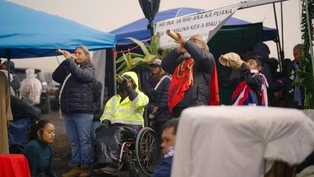
NewCommunity Protests Massive Telescope Atop a Sacred Mountain
Video has Closed Captions
Thousands of Native Hawaiians and protectors of Mauna Kea gather in protest. (2m 17s)
 New
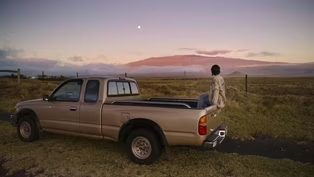
NewStanding Above The Clouds Preview
Video has Closed Captions
Native Hawaiian mother-daughter activists stand to protect their sacred Mauna Kea. (30s)
Providing Support for PBS.org
Learn Moreabout PBS online sponsorship












Support for PBS provided by:
Funding provided by the Corporation for Public Broadcasting and the National Endowment for the Arts.