
September 23, 2023 - PBS News Weekend full episode
9/23/2023 | 26m 43sVideo has Closed Captions
September 23, 2023 - PBS News Weekend full episode
Saturday on PBS News Weekend, we look at the changing landscape for applying to college after the Supreme Court’s landmark ruling on race-conscious admissions. Then, how driverless cars are chauffeuring passengers around select American cities, raising safety concerns along the way. Plus, why cricket is gaining popularity in the U.S. after declining for more than a century.
Problems playing video? | Closed Captioning Feedback
Problems playing video? | Closed Captioning Feedback
Major corporate funding for the PBS News Hour is provided by BDO, BNSF, Consumer Cellular, American Cruise Lines, and Raymond James. Funding for the PBS NewsHour Weekend is provided by...
Support provided by:

September 23, 2023 - PBS News Weekend full episode
9/23/2023 | 26m 43sVideo has Closed Captions
Saturday on PBS News Weekend, we look at the changing landscape for applying to college after the Supreme Court’s landmark ruling on race-conscious admissions. Then, how driverless cars are chauffeuring passengers around select American cities, raising safety concerns along the way. Plus, why cricket is gaining popularity in the U.S. after declining for more than a century.
Problems playing video? | Closed Captioning Feedback
How to Watch PBS News Hour
PBS News Hour is available to stream on pbs.org and the free PBS App, available on iPhone, Apple TV, Android TV, Android smartphones, Amazon Fire TV, Amazon Fire Tablet, Roku, Samsung Smart TV, and Vizio.
Providing Support for PBS.org
Learn Moreabout PBS online sponsorshipJOHN YANG: Tonight on PBS News Weekend, the changing landscape for college applicants after the Supreme Court's landmark ruling on race conscious admissions, then, where's my driver?
How driverless cars are chauffeuring passengers around select American cities, raising safety questions along the way.
And after more than a centuries long decline in America, why cricket is gaining popularity.
ADITHYA VENKATESH: I'm excited.
Because I mean, now like the cricket here is getting a lot better.
So at the end of the day, if we become like a great nation and cricket, we might be rivaling up against India about it's going to be fun.
(BREAK) JOHN YANG: Good evening, I'm John Yang.
On the day that fall officially begins a tropical storm is producing a large area of rain as it moves up the Atlantic coast, triggering flood watches and warnings along the way.
Ophelia came ashore this morning in North Carolina and is forecast to reach southeastern Virginia by this evening and be over water off the Atlantic coast by Monday.
With which winds already considerably diminished, the National Hurricane Center says the main threat is flooding from heavy rain.
More than a half foot of rain is forecast to fall in some areas.
Along the coast storm surge warnings are up as far north as the Chesapeake Bay.
Tens of thousands of people have already lost power from North Carolina to Pennsylvania.
North Carolina, Virginia and Maryland are all under states of emergency.
The family of a 17 year old black high school student in Texas who has been suspended for his hairstyle is suing Governor Greg Abbott and Attorney General Ken Paxton.
Darryl George's family says Abbott and Paxton have failed to protect his constitutional right against discrimination and his right to freedom of expression.
Georgia has been serving an in school suspension since late August when officials at Barbers Hill High School in the Houston area said his dreadlocks violate the school district's dress code.
A new Texas State law bans racial discrimination based on hairstyles.
Car dealers may soon be feeling the bite of the auto workers strike which begins its second week today.
With the work stoppage expanding to dozens of GM and Stellantis distribution hubs, the head of the National Association of auto dealers said parts shortages would soon put a crimp in dealer's highly profitable repair business.
President Biden will join a picket line in Michigan on Tuesday, and former President Trump is to visit the striking workers there on Wednesday.
Meanwhile, negotiators for Hollywood writers in the studios were back at the bargaining table for a fourth straight day, fueling hopes that an end to that nearly five month old strike may still be at hand.
But little progress is reported in the actors strike.
And Homeland Security Secretary Alejandro Mayorkas met today with Honduran Xiomara Castro in McAllen, Texas, to discuss cooperation on illegal migration.
The meeting caps a week that saw a big surge of migrants along the border.
More than 8,000 people entered the country illegally at Eagle Pass, Texas.
Illegal crossings dipped this spring but are on the rise again on pace to match last year's record highs.
Still to come on PBS News Weekend, driverless rides and the potential risks and rewards of Robo taxis and crickets booming popularity in America.
(BREAK) JOHN YANG: Colleges and college bound high school seniors are entering uncharted territory this fall, the first college application season in which schools are prohibited from considering race and ethnicity and making admissions decisions.
It's the result of June's landmark Supreme Court ruling that race conscious admissions are unconstitutional.
Admissions officials at selective schools have been anticipating this, and they've been thinking about it for a while.
But what about students and their families?
Sandy Baum is a Senior Fellow at the Urban Institute's Center on Education, Data and Policy.
Sandy, first of all, let's put this in perspective.
How many students in schools does this really affect?
SANDY BAUM, Senior Fellow, Urban Institute: That's a really important question, because you would think from the discussion that everyone is affected.
That's not true.
Most schools accept virtually all of their applicants.
And so it's only the schools that are highly selective, where it really is going to make a difference at all.
And the other issue is that it's really at the margin.
So the biggest fear is that students will hesitate to apply if they think, I'll never get in now that there is no affirmative action.
And the most important thing is for students to apply and give institutions the opportunity to accept them because of their qualifications.
JOHN YANG: Well, high school juniors, so we're thinking about applying to one of these selective schools, who are trying to make themselves attractive applicants, should they be doing anything differently now?
SANDY BAUM: Well, they should be thinking about the fact that they need to submit applications that will make it very clear who they are, what their strengths are.
And of course, they do have the opportunity to talk about the way that race or other personal characteristics have affected their experiences.
They should maybe apply to more schools, more selective schools, if they're they think their chances of anyone have gone down.
But they should still apply to the schools that they think will be the best fit for them.
The schools are eager to maintain diverse student bodies.
JOHN YANG: And as you say, this puts restrictions on what the schools can do.
But it doesn't restrict in any way what the applicants can do.
So they can still in essays and identify their race or ethnic background.
SANDY BAUM: They can, but institutions will have to be very careful not to accept students because of their race.
So they're going to want to get some advice from their guidance counselors, and try to read about how institutions are approaching this new dilemma.
So yeah, I mean, the biggest fear is that students will be afraid to apply.
Institutions are going to be working hard to prevent that from happening.
And there will be some students who don't get in who might have gotten in because of affirmative action, but they will get into another school instead.
They certainly should not decide it's hopeless to go to college to a four year college to a selective institution.
JOHN YANG: State schools in California and Michigan have been dealing with this for a while now.
Because of state referendums that ban race conscious admissions to students who are applying now can they take any lessons from students who are successful applicants to the college's state colleges in California and Michigan?
SANDY BAUM: Well, we know that when California, for example, banned affirmative action, the share of black and Hispanic students on those campuses really did go down significantly at the beginning, but it has crept back up.
And I mean, I think that the lesson is that institutions are working hard to get those students and that, you know, we just have to really hope that they will find ways for example, they could consider socio economic background, so they can give preference to people who have struggled against financially disadvantaged circumstances.
So really, the lesson for students is just not to be scared off and to represent themselves accurately and to highlight their strengths.
And let me say also that at the same time, the financial aid system is changing, and it's going to get easier to apply for financial aid.
And students want to be thinking about that, at the same time that they're thinking about where and how to do the admission applications.
The application is going to be shorter, it's going to be simpler.
And it's going to be easier to import your tax information from the IRS so that you don't have to answer all of the difficult questions.
Most students will be eligible for a little more financial aid than was the case before.
That won't be true for all students, but it will be true for most students.
So fill out the federal application for student aid and any other application that your institution requests apply, apply, apply.
JOHN YANG: While we're on the topic of financial aid.
The average cost of attending a state school tuition room board books the whole schmeer is about $27,000 this year and it's $55,000 of private schools.
The average graduate is coming out with student debt of about $30,000.
Is this worth it is college worth it for every student?
SANDY BAUM: College is not for every student, but it is worth it.
For most students, it's certainly very worth it on average.
The average earnings for people who get bachelor's degrees compared to the average earnings for people who don't go to college, there's such a gap that in a year or two or three, you're going to make up that difference.
If you're not prepared to study in college, if you think there's a small chance that you'll actually graduate, maybe you should take some time to think about it.
Do your research, go to an institution where there's a reasonably high graduation rate, and compare your financial aid offers because most students get financial aid, they don't pay those high sticker prices.
JOHN YANG: Now, after this decision, the Supreme Court decision there are other factors in admissions that are being examined legacy admissions sort of favoring children of alumni.
Now they're also talking about early decision that the critics say it favors wealthy and well-connected students.
Are we going to see more changes in this process?
SANDY BAUM: I think we'll see changes, we'll see the process evolve.
One real problem is that in this process, people who come from advantaged backgrounds people whose parents went to college, people who went to strong high schools have all kinds of advantages.
They are likely to have higher test scores.
They are likely to have taken more rigorous high school curricula.
They are likely to have more help filling out their applications.
They have more time for extracurricular activities.
So we're never going to eliminate the advantages that students from more privileged backgrounds have.
But I think there is going to be increasing effort to try to compensate as much as possible for the struggles that we know that many students face.
JOHN YANG: Sandy Baum of the Urban Institute's Center on Education, Data and Policy.
Thank you very much.
SANDY BAUM: Thank you so much.
JOHN YANG: Order a taxi and some select U.S. cities and the car that comes to pick you up won't have a driver just hop in and all by itself, the cab or robo-taxi takes you to your destination is Ali Rogin reports these vehicles are generating a lot of interest and controversy.
ALI ROGIN: With the cost of owning a car out of reach for many today ride sharing gives commuters an alternative.
And a handful of U.S. cities, self-driving taxis are getting the green light to pick up passengers.
Several companies including Waymo Cruise and Motional are touting driverless taxis as the way of the future.
But the rollout of these robo cabs has hit some speed bumps.
Not everyone is comfortable with autonomous cars on the road.
And major technical questions remain.
Aarian Marshall is a staff writer for WIRED, and she covers transportation.
Aarian, thank you so much for joining us.
Driverless vehicles autonomous functions on cars have been around for a while.
But how new is this concept of self-driving taxis?
AARIAN MARSHALL, Staff Writer, WIRED: Yeah, this is a pretty new thing in terms of something that's actually happening on the streets right now.
Waymo, which is a company that's associated with Google and Alphabet launched self-driving taxi services in Phoenix, Arizona a few years ago.
And now they're finally coming to San Francisco.
So it's something that researchers, developers, the tech industry has been working on for a number of years now.
And now it kind of seems like it's coming into fruition.
ALI ROGIN: And how does a system like this work?
We all know Uber.
Is it does it work like Uber?
And what is the user experience like?
AARIAN MARSHALL: Yeah, it's kind of exactly like Uber, you download an app onto your phone, if you happen to be in one of the cities where these taxi systems are operating.
And you hail it by pressing a button and it shows up to your door.
It's not in too many places right now.
It's in the Phoenix, Arizona metro area.
And then also in San Francisco is where they're offering paid rides.
So where you actually have to pay a fare to get into these driverless cars.
So it's a real taxi company.
But these companies have ambitions to expand very quickly.
Cruise, which is a General Motors subsidiary, has announced plans to come to 15 cities in 10 states, everywhere from North Carolina, to Texas to where I am in Seattle.
And Waymo is plans to come to Los Angeles, Austin.
So it's happening quickly.
ALI ROGIN: Now where are the price points right now for these rides in the cities that you can do this in?
And are they comparable to other ride sharing services that involve human beings?
AARIAN MARSHALL: Yeah, anyone who's taken and Uber or Lyft recently, might notice that prices have gone up a lot in recent years.
So there's definitely space there for robo-taxis to compete.
And right now, they're generally a bit lower than what you're seeing from those conventional human driven services.
And the other kind of nice thing is that you don't have to tip the robots.
So it might end up being a little lower overall.
ALI ROGIN: In California, in particular, there's been some blowback from especially emergency responders, what have been some of their concerns.
AARIAN MARSHALL: Yeah, emergency responders have been very concerned about the rollout of these robo-taxis in California.
In San Francisco, the fire department there has said they've had at least 55 negative run-ins with robo-taxis since the beginning of this year.
That's everything from them kind of freezing in the middle of the road and not allowing fire trucks to get by to them freezing in front of fire stations, so the fire trucks can't leave those fire stations as they're responding to emergencies.
So far, it doesn't seem like this has really affected emergency victims.
But it's something that officials in San Francisco are really concerned about and watching very closely.
ALI ROGIN: Now, in terms of the rider safety of these vehicles.
What is that like?
Are these cars safe?
AARIAN MARSHALL: Yeah, so this is definitely up for debate.
We do know that they've been built to be very cautious drivers.
The companies that build them say this is the absolutely the right approach.
I have heard from people in San Francisco, who say they're maybe a bit too cautious.
And they not only cause traffic jams, but one of the most frequent crashes that these things get into in San Francisco and the other cities where they're testing right now is they can get rear ended by people because they, for example, really do take full stops at stop signs.
And they might sometimes stop short when they think they see something scary on the roads ahead of them.
What the companies will tell you is that robots don't get drunk, they don't get tired, they don't get distracted.
So it's possible that these could be safer than humans now or perhaps down the line.
ALI ROGIN: Based on your reporting.
Is it your sense that these companies want to figure out these issues that we've talked about before they begin scaling out to other cities?
Or do they view these, as you just mentioned, not as bad as some of the hazards of driving in cars operated by humans.
AARIAN MARSHALL: These companies will tell you that they are safety first, but that they can't guarantee that a car is going to be a totally, totally perfect 100 percent driver without running them on the streets first.
So they are definitely kind of full steam ahead.
Now they believe the technology is ready and close to ready to deploy in more cities and in more places.
ALI ROGIN: And lastly, Aarian, so many people, especially during the pandemic turn to the gig economy to make ends meet.
What is the future for the jobs that are associated with ride sharing cars operated by humans are these driverless taxis going to run people out of jobs?
AARIAN MARSHALL: So this is something we heard a lot about from professional drivers in San Francisco as the state was considering last month, whether to allow paid robo-taxi services in the city of San Francisco.
We heard from Uber drivers.
We heard from professional taxi drivers who said these things are coming from my job.
And the companies will tell you yeah, that's kind of true.
That's going to happen but they say it's going to take a long time.
So it's not like they're going to flip a switch and all of the professional driving jobs will disappear.
ALI ROGIN: Aarian Marshall with WIRED, thank you so much.
AARIAN MARSHALL: Thanks for having me.
JOHN YANG: Cricket was once one of this country's most popular sports until baseball became entrenched as America's game during the Civil War.
Now the sport that was first played in England is seeing a resurgence here, thanks in part to thriving South Asian immigrant communities who revere the game.
Amna Nawaz takes us inside the world of wickets, stumps, batters and bowlers.
AMNA NAWAZ: It's game day in Germantown, Maryland.
Players warming up, parents settling in on the sidelines and the unmistakable sound of summer in America the crack of bet against ball.
But it's not baseball that brought these crowds out today.
It's cricket.
On this Sunday, two local youth cricket academies are squaring off.
Those are the Mavericks in red and the Jaguars and blue.
One of the first batters up for the Jaguars is 12 year old Aakash Venkatesh, whose journey to Cricket was a long one.
What was your first sport?
AAKASH VENKATESH, Local Youth Cricket Player: Soccer.
AMNA NAWAZ: And then after that?
AAKASH VENKATESH: Tennis.
AMNA NAWAZ: Then after that?
AAKASH VENKATESH: (Inaudible) AMNA NAWAZ: Was there any sport you didn't try ?
AAKASH VENKATESH: Football because too much contact.
AMNA NAWAZ: I hear that with other sports.
I'd like played it.
I had fun but then it got boring after a couple of weeks.
With cricket I just like felt that spark.
AMNA NAWAZ: A spark fanned into an all-consuming main passion by his parents including mom's Sunita who dutifully drives Aakash and big brother Adithya to dozens of matches every year across Maryland and Virginia.
SUNITHA VENKATESH, Mother of Aakash Venkatesh: We just love it.
I see the games going on.
I see parents cheering supporting the kids.
The loud keeps going on.
AMNA NAWAZ: Cricket keeps this family close.
It also filled every corner of their home from trophies lining the shelves.
ADITHYA VENKATESH: One of these ones I had 100 and this one here.
Not this one.
This one.
This one here was -- AMNA NAWAZ: So many you get them confused.
To a makeshift practice pitch in the basement.
Much of that enthusiasm comes from dad, Venky, who grew up loving the game in India.
VENKATESH KUMAR, Father of Adithya Venkatesh: I started playing cricket right when I was probably eight or nine years old, and had a dream built around cricket.
One day one wanted to be a cricket player.
AMNA NAWAZ: When the couple moved to America, more American sports took center stage.
VENKATESH KUMAR: We introduced them to all American sports initially.
They try tennis, soccer, basketball, swimming, but after a couple of weeks, the energy died down, and cricket was the last sport that was introduced to them.
AMNA NAWAZ: And this time it stuck.
AAKASH VENKATESH: We all played at some point or watched it sometimes we'd like put it on the TV, and then watch it all together.
It's just a fun thing to do together.
AMNA NAWAZ: The family trains together honing the boy skills in a game that's now catching on across the country.
And it's not as easy as it looks.
Cricket was invented in 17th century England and spread across the globe with the British Empire arriving in Australia, the West Indies and India by the 18th century.
The game is played on a 360 degree field with batters on one team trying to score runs by hitting the ball past fielders and a pitcher known as a bowler on the opposing team, all while protecting their wickets from the ball.
It remains most popular in former British colonies like India, Pakistan, South Africa and Australia.
So why is this old British game taking off in the United States?
AISHWARYA KUMAR, ESPN: A confluence of things is happening.
AMNA NAWAZ: Aishwarya Kuma of ESPN says immigration to the U.S. from Cricket obsessed nations is one reason.
AISHWARYA KUMAR: The South Asian American population is exponentially increasing.
It was 3.4 million back in 2010.
And it's 5.4 million now.
AMNA NAWAZ: Another is live streaming cricket, keeping fans connected to the highest level of play like the Indian Premier League, no matter where they live.
AISHWARYA KUMAR: There is a global movement around okay, we can stay in India and Australia and still watch cricket that's happening in the US.
AMNA NAWAZ: Another reason money, as the audience has grown here so has the financial investment.
AISHWARYA KUMAR: A lot of resources being poured into building stadiums and actually like making sure that there is infrastructure in place and resources in place to develop something from scratch and get people excited here.
AMNA NAWAZ: That something Major League Cricket or MLC launched this summer and American competition hoping to win viewers around the world.
VIJAY SRINIVASAN, Founder, Major League Cricket: We think for the casual American sports fan who's never seen a game should come and take a look at one and I think there'll be AMNA NAWAZ: Vijay Srinivasan is co-founder of the league.
VIJAY SRINIVASAN: It's not the traditional image of cricket had many people in America, which lasts several days.
And you know, there's people dressed in white clothes and sit down for a cup of tea and wait for lunch and so on.
AMNA NAWAZ: The league featuring six teams from across the country was a passion project for Srinivasan.
e founded a live streaming cricket channel in the early 2000s, which showed him there was a viewer base in the U.S. hungry for elite competition.
This season sold out most games and Srinivasan says there are plans to build more stadiums and infrastructure.
VIJAY SRINIVASAN: That's going to change the landscape for cricket, usually in this country.
And also me with the Cricket World Cup coming to the U.S. next year.
It's going to be a very different picture a few years from now.
AMNA NAWAZ: A picture that may feed your future pros like Aakash and Adithya who is now trying out for the under 19 Team USA.
So I'm going to ask you both a question and I want you to both answer at the same time on the count of three ready?
Who's the better player?
One, two, three go.
ADITHYA VENKATESH: At the moment.
I'm excited you know because I mean now like the cricket here is getting a lot better.
So at the end of the day if we become like a like a great nation and cricket, we might be rivaling up against India, Pakistan, those kinds of teams that it's going to be fun.
AMNA NAWAZ: What's it like for you as a parents to watch your children succeed in this sport that clearly means so much to you?
VENKATESH KUMAR: It's kind of a dream come true.
Nothing else apart from that, and I can say I'm living my dream through them.
AMNA NAWAZ: A dream carried across an ocean and a generation that found new life here in the US.
For PBS News Weekend, I'm Amna Nawaz in Maryland.
JOHN YANG: Online tomorrow morning watch live as a capsule carrying the first asteroid samples collected in space returns to earth.
All that and more is on our website, pbs.org/newshour.
And that is PBS News Weekend for this Saturday.
I'm John Yang.
For all of my colleagues, thanks for joining us on this first of fall.
See you tomorrow.
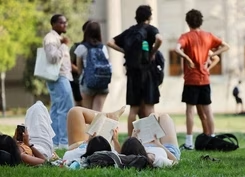
College hopefuls face changing admissions landscape
Video has Closed Captions
College hopefuls face changing admissions landscape after Supreme Court ruling (7m 4s)
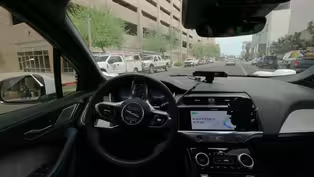
Rollout of driverless cabs raises safety questions
Video has Closed Captions
Rollout of driverless cabs in select U.S. cities raises safety questions (6m 18s)

Why cricket is having a resurgence in popularity in America
Video has Closed Captions
Why cricket is having a resurgence in popularity in America (6m 59s)
Providing Support for PBS.org
Learn Moreabout PBS online sponsorship
- News and Public Affairs

FRONTLINE is investigative journalism that questions, explains and changes our world.

- News and Public Affairs

Amanpour and Company features conversations with leaders and decision makers.












Support for PBS provided by:
Major corporate funding for the PBS News Hour is provided by BDO, BNSF, Consumer Cellular, American Cruise Lines, and Raymond James. Funding for the PBS NewsHour Weekend is provided by...