
News Wrap: Supreme Court to hear birthright citizenship case
Clip: 12/5/2025 | 6m 36sVideo has Closed Captions
News Wrap: Supreme Court to hear case on Trump’s order ending birthright citizenship
In our news wrap Friday, the Supreme Court agreed to take up the question of whether President Trump’s order ending birthright citizenship is legal, a federal judge ordered the release of materials from the 2005 and 2007 grand jury investigations into Jeffrey Epstein and a man charged with planting pipe bombs in Washington on the eve of Jan. 6 reportedly confessed in interviews with investigators.
Problems playing video? | Closed Captioning Feedback
Problems playing video? | Closed Captioning Feedback
Major corporate funding for the PBS News Hour is provided by BDO, BNSF, Consumer Cellular, American Cruise Lines, and Raymond James. Funding for the PBS NewsHour Weekend is provided by...
News Wrap: Supreme Court to hear birthright citizenship case
Clip: 12/5/2025 | 6m 36sVideo has Closed Captions
In our news wrap Friday, the Supreme Court agreed to take up the question of whether President Trump’s order ending birthright citizenship is legal, a federal judge ordered the release of materials from the 2005 and 2007 grand jury investigations into Jeffrey Epstein and a man charged with planting pipe bombs in Washington on the eve of Jan. 6 reportedly confessed in interviews with investigators.
Problems playing video? | Closed Captioning Feedback
How to Watch PBS News Hour
PBS News Hour is available to stream on pbs.org and the free PBS App, available on iPhone, Apple TV, Android TV, Android smartphones, Amazon Fire TV, Amazon Fire Tablet, Roku, Samsung Smart TV, and Vizio.
Providing Support for PBS.org
Learn Moreabout PBS online sponsorshipGEOFF BENNETT: Welcome to the "News Hour."
The U.S.
Supreme Court has agreed to take up the question of whether President Trump's order ending birthright citizenship is legal.
The decision follows Trump's appeal of a lower court ruling that struck down his executive order as unconstitutional.
At issue is nothing less than the future of the 14th Amendment, which guarantees citizenship to anyone born or naturalized in the U.S.
It's another major Trump immigration policy to reach the court, and the outcome could redefine a core principle of American law.
The case will be argued this spring.
Separately, a federal judge in Florida has ordered the release of materials from the 2005 and 2007 grand jury investigations into the late convicted sex offender Jeffrey Epstein.
A similar request was denied earlier this year, but U.S.
District Judge Rodney Smith said he is now granting the Justice Department's renewed petition in light of a new law Congress passed last month requiring the department to disclose all of its records related to Epstein.
It remains unclear when the documents will be made public, but the law sets a deadline of December 19.
The Virginia man charged with planting pipe bombs in Washington, D.C., on the eve of the January 6 Capitol attack reportedly confessed to the act in interviews with investigators; 30-year-old Brian Cole Jr.
did not enter a plea at his initial court appearance today.
Sources familiar with the investigation say Cole believed Donald Trump's false claims about being cheated out of a victory in the 2020 election.
Law enforcement officials have not publicly disclosed a motive.
Cole is due back in court mid-December for a detention hearing.
The Trump administration has unveiled its national security strategy.
That's a congressionally mandated document that each administration uses as its world view.
This one focuses overwhelmingly on the Western Hemisphere.
The 33-page document said the U.S.
would reorient its global military presence with the focus closer to home, countering migration and combating drug trafficking.
It also took aim at longtime European allies, saying they hold unrealistic expectations for the war in Ukraine and making clear that the U.S.
wants to mend its relationship with Russia.
The document also calls for an end to NATO expansion and it charges Europe with taking primary responsibility for its own defense.
Residents in Eastern Congo say fighting still rages on in that country despite the peace deal signed by the Congolese and Rwandan leaders in Washington yesterday.
ALEXIA KASEREKA, Congo Resident (through translator): They talk every day, but the wars never end.
For example, they are signing the peace agreement, but the fighting has continued.
We ask our leaders that discussions be fair and truly bring peace.
GEOFF BENNETT: Others expressed cautious optimism about the deal, even as fighting intensified in recent days between Congolese government forces and M23 rebels believed to be backed by Rwanda.
The region has endured decades of conflict rooted in the fallout of Rwanda's 1994 genocide and longstanding tensions between ethnic groups, among other factors.
Congo and M23 agreed to a cease-fire just last month, but both sides accused the other of violating it.
On Wall Street, stocks closed positive for the day and the week.
The Dow Jones industrial average gained a little more than 100 points, the Nasdaq rose by more than 70, and the S&P 500 inched closer to its all-time record high.
The largest ever FIFA World Cup is beginning to take shape as soccer fans worldwide learned their country's opponents when the global tournament kicks off next summer in venues all across North America.
DONALD TRUMP, President of the United States: This is shocking.
MAN: United States of America.
(APPLAUSE) GEOFF BENNETT: President Trump and fellow host nation leaders Claudia Sheinbaum of Mexico and Mark Carney of Canada kicked off the draw from the Kennedy Center in Washington, D.C.
A record 48 teams will take part in next year's tournament.
As for the U.S.
draw, we're set to face Paraguay and Australia and a European playoff winner that will be decided in March.
During the event, President Trump was also named the winner of the inaugural FIFA Peace Prize, which he declared one of the greatest honors of his life.
The prize, seemingly tailor-made for him, comes as Mr.
Trump has openly campaigned for the Nobel Peace Prize.
In other sports news, one of the most impressive streaks in the history of sports came to an end last night.
LeBron James, the NBA's all-time leading scorer, failed to put up 10 or more points in a regular season game for the first time in nearly 19 years.
ANNOUNCER: Rui wins it!
And James gave him the basketball.
GEOFF BENNETT: James had a chance to extend his streak on the final possession, but passed the ball for the game-winning assist instead.
He was held to just eight points in the Lakers' win over the Toronto Raptors.
His scoring streak started in 2007, by far the longest in NBA history.
After the game, James said he had no regrets about passing the ball, adding simply: "We won."
And a passing of note.
Famed architect Frank Gehry has died.
He passed away at his home in Santa Monica, California, after a brief respiratory illness.
Gehry was the genius behind some of the most imaginative buildings ever constructed, like the Guggenheim Museum in Spain and the Walt Disney Concert Hall in Los Angeles, sleek, fluid, mind-bending structures that look as mathematical as they are original.
Gehry won just about every architectural accolade, including the field's top honor, the Pritzker Prize, which called his work refreshingly original and totally American.
Our arts and culture correspondent, Jeffrey Brown, spoke with him back in 2015, where he responded to critics who called his designs showy and overwhelming.
FRANK GEHRY, Architect: They're not ego trips in the negative sense of an ego trip.
I mean, you see a lot of so-called architecture that part of the ego trip overpowers the functionality and the budget and all that stuff.
So it's the essence.
It's finding an essence.
Why be expressive on the outside?
Because everything around isn't.
GEOFF BENNETT: Frank Gehry was 96 years old.
Still to come on the "News Hour": David Brooks and Jonathan Capehart weigh in on the week's political headlines; and we sit down with actor Nick Offerman for the latest episode of our podcast "Settle In."
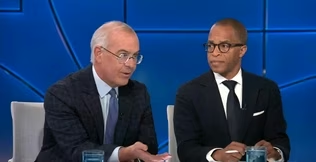
Brooks and Capehart on fallout over Trump's boat strikes
Video has Closed Captions
Clip: 12/5/2025 | 10m 25s | Brooks and Capehart on the political fallout over Trump's boat strikes (10m 25s)
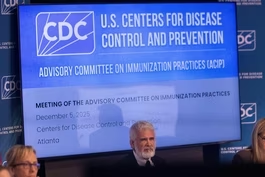
CDC panel drops hepatitis B vaccine at birth recommendation
Video has Closed Captions
Clip: 12/5/2025 | 7m 29s | RFK-appointed CDC panel drops hepatitis B vaccine at birth recommendation (7m 29s)

Nick Offerman joins Geoff Bennett on our ‘Settle In’ podcast
Video has Closed Captions
Clip: 12/5/2025 | 5m 46s | Nick Offerman joins Geoff Bennett for our ‘Settle In’ podcast (5m 46s)

Trump’s threats raise fears in Minnesota’s Somali community
Video has Closed Captions
Clip: 12/5/2025 | 7m 9s | Fraud scandals and Trump’s rhetoric escalate fears in Minnesota’s Somali community (7m 9s)

What Netflix's deal to buy Warner Bros. means for Hollywood
Video has Closed Captions
Clip: 12/5/2025 | 6m 39s | What Netflix's deal to buy Warner Bros. means for one of Hollywood's oldest studios (6m 39s)
Providing Support for PBS.org
Learn Moreabout PBS online sponsorship
- News and Public Affairs

FRONTLINE is investigative journalism that questions, explains and changes our world.

- News and Public Affairs

Today's top journalists discuss Washington's current political events and public affairs.









Support for PBS provided by:
Major corporate funding for the PBS News Hour is provided by BDO, BNSF, Consumer Cellular, American Cruise Lines, and Raymond James. Funding for the PBS NewsHour Weekend is provided by...