
December 5, 2025 - PBS News Hour full episode
12/5/2025 | 57m 46sVideo has Closed Captions
December 5, 2025 - PBS News Hour full episode
December 5, 2025 - PBS News Hour full episode
Problems playing video? | Closed Captioning Feedback
Problems playing video? | Closed Captioning Feedback
Major corporate funding for the PBS News Hour is provided by BDO, BNSF, Consumer Cellular, American Cruise Lines, and Raymond James. Funding for the PBS NewsHour Weekend is provided by...
December 5, 2025 - PBS News Hour full episode
12/5/2025 | 57m 46sVideo has Closed Captions
December 5, 2025 - PBS News Hour full episode
Problems playing video? | Closed Captioning Feedback
How to Watch PBS News Hour
PBS News Hour is available to stream on pbs.org and the free PBS App, available on iPhone, Apple TV, Android TV, Android smartphones, Amazon Fire TV, Amazon Fire Tablet, Roku, Samsung Smart TV, and Vizio.
Providing Support for PBS.org
Learn Moreabout PBS online sponsorshipGEOFF BENNETT: Good evening.
I'm Geoff Bennett.
Amna Nawaz is away.
On the "NewsHour" tonight: The CDC's vaccine committee changes recommendations for hepatitis B shots for newborns, in a major shift for childhood immunizations.
The world's largest streaming service announces plans to acquire one of Hollywood's oldest studios.
And Minnesota's Somali community pushes back against President Trump's rhetorical attacks, as it prepares for immigration raids.
WARIS MOHAMUD, Business Owner: I want he change his tongue, because he doesn't know us.
Come over here, Donald Trump.
You are our president.
(BREAK) GEOFF BENNETT: Welcome to the "News Hour."
The U.S.
Supreme Court has agreed to take up the question of whether President Trump's order ending birthright citizenship is legal.
The decision follows Trump's appeal of a lower court ruling that struck down his executive order as unconstitutional.
At issue is nothing less than the future of the 14th Amendment, which guarantees citizenship to anyone born or naturalized in the U.S.
It's another major Trump immigration policy to reach the court, and the outcome could redefine a core principle of American law.
The case will be argued this spring.
Separately, a federal judge in Florida has ordered the release of materials from the 2005 and 2007 grand jury investigations into the late convicted sex offender Jeffrey Epstein.
A similar request was denied earlier this year, but U.S.
District Judge Rodney Smith said he is now granting the Justice Department's renewed petition in light of a new law Congress passed last month requiring the department to disclose all of its records related to Epstein.
It remains unclear when the documents will be made public, but the law sets a deadline of December 19.
The Virginia man charged with planting pipe bombs in Washington, D.C., on the eve of the January 6 Capitol attack reportedly confessed to the act in interviews with investigators; 30-year-old Brian Cole Jr.
did not enter a plea at his initial court appearance today.
Sources familiar with the investigation say Cole believed Donald Trump's false claims about being cheated out of a victory in the 2020 election.
Law enforcement officials have not publicly disclosed a motive.
Cole is due back in court mid-December for a detention hearing.
The Trump administration has unveiled its national security strategy.
That's a congressionally mandated document that each administration uses as its world view.
This one focuses overwhelmingly on the Western Hemisphere.
The 33-page document said the U.S.
would reorient its global military presence with the focus closer to home, countering migration and combating drug trafficking.
It also took aim at longtime European allies, saying they hold unrealistic expectations for the war in Ukraine and making clear that the U.S.
wants to mend its relationship with Russia.
The document also calls for an end to NATO expansion and it charges Europe with taking primary responsibility for its own defense.
Residents in Eastern Congo say fighting still rages on in that country despite the peace deal signed by the Congolese and Rwandan leaders in Washington yesterday.
ALEXIA KASEREKA, Congo Resident (through translator): They talk every day, but the wars never end.
For example, they are signing the peace agreement, but the fighting has continued.
We ask our leaders that discussions be fair and truly bring peace.
GEOFF BENNETT: Others expressed cautious optimism about the deal, even as fighting intensified in recent days between Congolese government forces and M23 rebels believed to be backed by Rwanda.
The region has endured decades of conflict rooted in the fallout of Rwanda's 1994 genocide and longstanding tensions between ethnic groups, among other factors.
Congo and M23 agreed to a cease-fire just last month, but both sides accused the other of violating it.
On Wall Street, stocks closed positive for the day and the week.
The Dow Jones industrial average gained a little more than 100 points, the Nasdaq rose by more than 70, and the S&P 500 inched closer to its all-time record high.
The largest ever FIFA World Cup is beginning to take shape as soccer fans worldwide learned their country's opponents when the global tournament kicks off next summer in venues all across North America.
DONALD TRUMP, President of the United States: This is shocking.
MAN: United States of America.
(APPLAUSE) GEOFF BENNETT: President Trump and fellow host nation leaders Claudia Sheinbaum of Mexico and Mark Carney of Canada kicked off the draw from the Kennedy Center in Washington, D.C.
A record 48 teams will take part in next year's tournament.
As for the U.S.
draw, we're set to face Paraguay and Australia and a European playoff winner that will be decided in March.
During the event, President Trump was also named the winner of the inaugural FIFA Peace Prize, which he declared one of the greatest honors of his life.
The prize, seemingly tailor-made for him, comes as Mr.
Trump has openly campaigned for the Nobel Peace Prize.
In other sports news, one of the most impressive streaks in the history of sports came to an end last night.
LeBron James, the NBA's all-time leading scorer, failed to put up 10 or more points in a regular season game for the first time in nearly 19 years.
ANNOUNCER: Rui wins it!
And James gave him the basketball.
GEOFF BENNETT: James had a chance to extend his streak on the final possession, but passed the ball for the game-winning assist instead.
He was held to just eight points in the Lakers' win over the Toronto Raptors.
His scoring streak started in 2007, by far the longest in NBA history.
After the game, James said he had no regrets about passing the ball, adding simply: "We won."
And a passing of note.
Famed architect Frank Gehry has died.
He passed away at his home in Santa Monica, California, after a brief respiratory illness.
Gehry was the genius behind some of the most imaginative buildings ever constructed, like the Guggenheim Museum in Spain and the Walt Disney Concert Hall in Los Angeles, sleek, fluid, mind-bending structures that look as mathematical as they are original.
Gehry won just about every architectural accolade, including the field's top honor, the Pritzker Prize, which called his work refreshingly original and totally American.
Our arts and culture correspondent, Jeffrey Brown, spoke with him back in 2015, where he responded to critics who called his designs showy and overwhelming.
FRANK GEHRY, Architect: They're not ego trips in the negative sense of an ego trip.
I mean, you see a lot of so-called architecture that part of the ego trip overpowers the functionality and the budget and all that stuff.
So it's the essence.
It's finding an essence.
Why be expressive on the outside?
Because everything around isn't.
GEOFF BENNETT: Frank Gehry was 96 years old.
Still to come on the "News Hour": David Brooks and Jonathan Capehart weigh in on the week's political headlines; and we sit down with actor Nick Offerman for the latest episode of our podcast "Settle In."
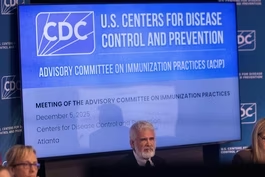
The federal government's vaccine advisory panel, all of whom were appointed by Health Secretary Robert F. Kennedy Jr., today voted to drop the recommendation that all babies get vaccinated for hepatitis B at birth.
Instead, the panel recommended that parents consult with doctors.
William Brangham looks at this sharp break in practice and other significant revisions being considered for childhood vaccinations.
WILLIAM BRANGHAM: That's right, Geoff.
For decades in the U.S., the hepatitis B vaccine has been recommended for all newborns.
Hepatitis B is a serious virus.
It affects the liver and infection can lead to major health problems, including cirrhosis and liver cancer.
Newborns are especially vulnerable to this blood-borne virus, and a baby exposed at birth has a 90 percent chance of a lifelong infection.
The vaccine has been shown to be highly effective in preventing infection if given within 24 hours of birth.
So, joining us now is pediatrician Dr.
Paul Offit.
He directs the Vaccine Education Center at Children's Hospital of Philadelphia.
Dr.
Offit, so good to have you back on the program.
You were invited to testify before this panel, but you said no.
You are a longtime supporter of this previous recommendation that all babies born get hepatitis B vaccine.
Why?
DR.
PAUL OFFIT, Children's Hospital of Philadelphia: Well, so in 1991, when the recommendation was to have a birth dose for all babies, babies whose mothers had hepatitis B infection or babies whose mothers didn't have hepatitis B infection, because, at the time, 30,000 children less than 10 years of age had hepatitis B. Half of them got it from their mothers.
The other half didn't.
The other half got it from relatively casual contact with someone who had chronic hepatitis B. And there were millions of people in this country then and millions of people in this country now who have chronic hepatitis B. And this can be transmitted fairly casually.
I mean, if you live in that home or if you share any sort of common things like toothbrushes or washcloths or towels or nail clippers, you can get hepatitis B; 15,000 children got hepatitis B, not from their mothers.
And that -- with that, with that recommendation, we virtually eliminated this disease in children less than 10 years of age.
But this Advisory Committee for Immunization Practices, RFK Jr.
's committee, doesn't recognize that.
And so they're now trying to put children in harm's way again.
WILLIAM BRANGHAM: I mean, what they're arguing is that the risk to a baby is low and test the mother, and if the mother has hep B, then you should vaccinate, but, if not, maybe you can consider that.
What do you make of that argument?
DR.
PAUL OFFIT: I think it's not founded on the epidemiology.
I mean, if it was true that children would not come in contact with anyone who had chronic infection and therefore be at risk of this disease, then that would make sense.
But you knew that, in the early '90s, 15,000 children less than 10 years of age got hepatitis B. They didn't get it from being sex workers.
They didn't get it from being intravenous drug users.
They got it from coming in contact with one of the millions and millions of people in this country who have chronic hepatitis B. And most people who have chronic hepatitis B don't know that they have it.
So testing the mother is not good enough.
What you should do is, you should test everybody with whom this baby comes in contact or this young child comes in contact, which obviously is not possible to do.
So the more reasonable thing to do is to just vaccinate all babies, because we actually had a birth dose recommendation only for babies whose mothers had hepatitis B from 1982 to 1991, and made little impact on this disease in young children.
It wasn't until we had the birth dose for all that we made an impact.
This committee, this Robert F. Kennedy Jr.
anti-vaccine, anti-science committee, wants us to bring us back to the '80s, when we had little impact on the instance of hepatitis B in children.
WILLIAM BRANGHAM: One of the supporters of the old guidance, someone who aligns with your view on this, kept asking today, what is the harm of these vaccines?
We know that, very recently, Secretary Kennedy has linked the hepatitis B vaccine with a shockingly high rate of autism.
He cites a 1990s Belgian study that showed, he says, shockingly high rates following vaccination.
Is there any truth to that?
Is there any demonstrable evidence that these vaccines cause harm?
DR.
PAUL OFFIT: No.
And the study that he references doesn't show that either.
But when do we start to get to the point where we don't believe Robert F. Kennedy Jr.?
When he claimed that the measles, mumps, rubella vaccine caused autism, he made a movie called "Vaxxed II."
He was the executive producer claiming MMR vaccine causes autism.
Then, when the fear was that thimerosal, this ethylmercury-containing preservative vaccines, caused autism, he wrote a book, "Thimerosal: Let the Science Speak."
And thimerosal, study after study showed that didn't cause autism.
Then, in April of this year, he said, I'm going to have a major announcement.
Autism is preventable.
We're going to have a major announcement in September.
And, in September, Donald Trump stepped up to the microphone and said, Tylenol causes autism, which isn't true either.
There's two excellent studies in Sweden and Japan that show that's not true.
When does he start to lose credibility?
WILLIAM BRANGHAM: There was another representative from the FDA today who put up a lot of evidence arguing that the U.S.
compared to European nations, other developed nations, is an outlier when it comes to vaccinating children.
Is there any truth to that?
DR.
PAUL OFFIT: Well, we believe in giving vaccines to children if it prevents a disease that causes children to suffer or be hospitalized or die.
We are willing to spend the money to do that.
Not all developed world nations are willing to do that.
So, we care about our children and want to make sure that they don't suffer.
So, for example, some European countries choose not to give the chicken pox vaccine.
But in this country, chicken pox caused 10,000 hospitalizations a year.
It caused 75 to 100 children primarily to die every year.
So, if you can prevent it, prevent it.
And that's where we stand.
WILLIAM BRANGHAM: Last question.
There was a lawyer, an anti -- notorious anti-vaccine lawyer, Aaron Siri, who made a long presentation arguing today that pharmaceutical companies, because Congress has given them liability protections, don't test the vaccines and that federal regulators are overlooking any evidence of harm.
What does it say to you that we have someone like that testifying before what is supposed to be our preeminent vaccine panel?
DR.
PAUL OFFIT: Well, it tells you that we no longer have that vaccine panel being preeminent.
I think they are not to be trusted.
I think the CDC is not to be trusted.
I think Robert F. Kennedy Jr.
has now basically elevated anti-vaccine activism into public policy.
And for the most part, I think the good news is, the medical community, the scientific community now ignores the ACIP, ignores the CDC.
The American Academy of Pediatrics put out today a very clear directive that we are recommending this birth dose for everybody.
And here's why, ignoring what this group is doing.
And, hopefully, everybody will ignore them because they're worth ignoring.
WILLIAM BRANGHAM: Dr.
Paul Offit, thank you so much for being here.
DR.
PAUL OFFIT: Thank you.
GEOFF BENNETT: Netflix has struck a nearly $83 billion deal to acquire Warner Bros., beating out Paramount and Comcast after a bidding war.
If finalized, it would unite the world's largest streamer with one of Hollywood's oldest studios, giving Netflix access to major franchises like the D.C.
Universe, "Game of Thrones," and Harry Potter.
Warner Bros.
would spin off cable networks, including CNN, TNT, and TBS before the deal closes.
The move raises big questions about the future of theatrical releases and serious concerns about market concentration.
It's expected to face intense antitrust scrutiny from the Trump Justice Department.
Joining us now to break it all down is Matt Belloni, founding partner of Puck and author of puck's What I'm Hearing newsletter.
Thanks for being with us.
MATTHEW BELLONI, Puck News: Thanks for having me.
GEOFF BENNETT: So, Netflix built its reputation, it's prided itself on being a builder, rather than a buyer.
So what does it want with Warner Bros., and why now?
MATTHEW BELLONI: I think there's a couple things.
I mean, Netflix, as prolific as it is, it does not have the intellectual property that has accrued at a 100-year-old studio, everything from Batman and Superman to Harry Potter to all the films that are in the Warner Bros.
library.
They can both exploit that on their service, put the films directly on the service, and they can also make new films and TV shows based on that I.P.
And for a service like Netflix that's really only been making original content for about a decade, that is extremely valuable.
And on the HBO side, that's a big competitor.
So they take that competitor out, and they also have now a premium version of a streamer to put next to Netflix, where they could use it as an upsell, they could bundle it together, they can get a whole lot of data from it.
They can do a lot of things with that.
So it's really valuable from both streaming and the studio side.
GEOFF BENNETT: A group of film producers sent an open letter to Congress warning of -- this is a quote -- "cascading disastrous outcomes if this deal goes through."
The Writers Guild of America is also opposed to it.
They basically see this as giving Netflix monopolistic control over the industry.
Do you see those concerns as being valid?
MATTHEW BELLONI: I do.
I think that any time you take a buyer out of the entertainment ecosystem, that's necessarily going to trickle down to talent.
Now, if you ask Netflix, they say they're going to be making more.
They're going to do more with these assets.
But history has shown that, when you buy something, there are synergies.
You don't compete against each other for talent.
And, overall, it helps depress the prices that people are able to get from you.
So I do see it.
Now, the extent of those concerns are really what's at stake here, because it could be a small problem.
It could be a catastrophic problem.
If HBO Max simply goes away and Netflix kills it, then that's a huge problem for the talent community.
If Warner Bros.
stops licensing its films out to other services, or if it stops making TV shows for other services, that's a big problem for the creative community.
I think there's a lot of anxiety within Hollywood right now, because we just don't know what's going to happen.
And that leads all of these organizations to the darkest place.
And they're just trying to plant their flag right now and say, OK, this could be very bad.
GEOFF BENNETT: What kind of oversight is the Trump administration expected to bring to this deal?
MATTHEW BELLONI: There's a couple things.
I mean, it's not the transfer of a broadcast television license, so the FCC does not get involved here.
But the Justice Department can sue to block this merger if it feels that it runs afoul of antitrust concerns.
That actually happened when this company, Time Warner, was sold two times ago.
And the first Trump administration sued to block it.
It lasted about two years.
Ultimately, the deal was allowed to go through, but it really hampered that company when it merged with AT&T.
Now there's the added element of politics in here, because the other bidder that did not get this asset is Paramount, which is owned by the Ellison family.
And the Ellison family has pretty close ties to Trump.
And when the Ellisons bought CBS earlier this year, they installed some more Trump-friendly figures at that company.
So the speculation was that Trump really wanted the Ellison family to buy this company and own CNN, so that it could put their own friendlier people at CNN.
That didn't happen.
And perhaps the Trump administration would intervene here to stop this.
GEOFF BENNETT: If this merger goes through, what would it mean for CNN and Warner's other cable assets?
MATTHEW BELLONI: Well, this is the interesting thing.
Netflix is not buying the cable networks.
The other suitor, Paramount, wanted to buy everything, but Netflix didn't.
They don't want to be in the cable television business.
So what's going to happen is, these television assets, including CNN, are going to be spun off into a new company that will debut, they plan, next year.
So when that happens, anyone can come along and buy CNN.Could be the Ellison family that already owns CBS.
It could be some other rich person.
It could be another company in the media space.
But CNN will essentially be up for sale when this spin-off happens.
GEOFF BENNETT: What are you watching for is this potential merger progresses?
MATTHEW BELLONI: I'm watching to see if the Ellison family, the other suitor, they might go hostile on this merger.
They might say that this was a bum deal, that they were not given the opportunity to overpay or outbid the entity that got it, Netflix.
And they could go directly to the shareholders to stop this.
They could also sue.
Or they could put together a bigger bid and try to steal it away from Netflix.
That happened when FOX was sold about a decade ago.
Comcast came in and tried to block Disney from buying the FOX assets with a bigger bid, and ultimately made Disney pay more money to acquire FOX than it would have if they had not come along.
So this is the early days of this merger, even though they have a signed deal.
GEOFF BENNETT: Matt Belloni of Puck, thanks so much for walking us through all this.
We appreciate it.
MATTHEW BELLONI: Thank you.
GEOFF BENNETT: President Trump in recent days has taken aim at Minnesota's Somali community with xenophobic remarks and calls for removal from the U.S.
It coincides with the new ICE operation in the Twin Cities that's resulted in at least five arrests of Somali immigrants.
Special correspondent Fred de Sam Lazaro has this report on the community's response and how we got here, including a sweeping fraud scandal that's gripping the state.
FRED DE SAM LAZARO: At Karmel Mall, a hub for Somali life and culture in south Minneapolis, business has been slower than usual this week.
WOMAN: It's very scary, especially the small business owner.
For us, for me, well, all the business, Karmel Mall, we're not making any monies.
FRED DE SAM LAZARO: Concern rose here after word of an increase in federal immigration enforcement targeting Minnesota's Somali community.
The state is home to about 80,000 people of Somali descent, the largest such population in the country.
Most are citizens and many were born here.
The stepped-up enforcement, dubbed Operation Metro Surge, follows President Trump's repeated attacks on Minnesota's Somali community.
DONALD TRUMP, President of the United States: They contribute nothing.
I don't want them in our country, I will be honest with you.
Their country stinks.
FRED DE SAM LAZARO: The president also singled out Ilhan Omar, the progressive Somalia-born Minnesota congresswoman, who he's long criticized.
DONALD TRUMP: Ilhan Omar is garbage.
She's garbage.
Her friends are garbage.
These aren't people that work.
These aren't people that say, let's go.
Come on.
Let's make this place great.
These are people that do nothing but complain.
MAN: I was shocked, bro.
I was like, what?
I was just like, really?
He said that?
I mean, I have seen him say crazy things, but now he hits home.
FRED DE SAM LAZARO: The comments sparked an uproar in Minnesota's Somali community.
WOMAN: We really thought, wow.
Why would somebody to call a whole community and say you're garbage or you stink?
Actually, we smell really good.
FRED DE SAM LAZARO: Even Somali Americans who voted for Trump, like business owner Waris Mohamud, expressed anger.
WARIS MOHAMUD, Business Owner: We want he make America great, but not insulting the people.
He is the president.
I want he change his tongue, because he doesn't know us.
Come over here, Donald Trump.
You are our president.
Come over here, have a tea, and you will learn who we are.
FRED DE SAM LAZARO: President Trump targeted Somali immigrants in his first term too.
But his rhetoric sharpened dramatically this week amid increased national attention to a series of massive Minnesota fraud scandals in which almost all of the dozens of people charged so far are of Somali descent.
In one case, hundreds of millions of dollars were allegedly stolen from a program meant to feed children during the pandemic.
Officials called it the largest COVID era fraud scheme in the country.
Authorities later said there was large-scale fraud in a program designed to help people with disabilities get housing.
And in September, a woman was charged for defrauding a state autism treatment program.
All told, federal prosecutors estimate fraud in Minnesota could cost taxpayers over a billion dollars.
When you started to read about these fraud stories, what was your reaction as a Somali American?
AHMED SAMATAR, Macalester College: Well, I was ashamed.
FRED DE SAM LAZARO: Ahmed Samatar is an international studies professor at Macalester College in st.
Paul.
Originally from Somalia, he's lived in Minnesota for over 30 years.
He says Somalis mostly started arriving here in the 1990s, fleeing their country's civil war.
They were drawn to Minnesota's generous safety net, including refugee resettlement nonprofits based here.
That's partly why he was so angered by Somalis' involvement in the fraud cases.
AHMED SAMATAR: Somali Minnesotans have to face this, and they really have to clean up their act, because the state deserves better than that.
But I think the challenge is to keep that in its proper place, because it's a real story, and then, next to it, expound on what the Somalis have achieved in the state of Minnesota.
FRED DE SAM LAZARO: But, as scrutiny of Minnesota's Somali community spikes, so does criticism of Governor Tim Walz for failing to heed early warnings about fraud and to do enough to combat it.
GOV.
TIM WALZ (D-MN): You commit fraud in Minnesota, you're going to prison.
I don't care what color you are, what religion you are.
Anybody who wants to help us in that, we welcome that.
But sitting on the sidelines and throwing out accusations and, let's be very clear, demonizing an entire population and lying to people about the safety and security of the state, is beneath that.
FRED DE SAM LAZARO: The topic will likely dominate next year's gubernatorial election, when a crowded Republican field will try to stop Walz from winning a third term.
One of his challengers is Minnesota House Speaker Lisa Demuth.
STATE REP.
LISA DEMUTH (R-MN): This does point to Governor Walz, because whether or not some of it preceded him, it has exploded during his time leading our state.
And there has not been that accountability that taxpayers are counting on.
FRED DE SAM LAZARO: What do you think about what has emerged since, which is a racialization at many levels of this issue?
STATE REP.
LISA DEMUTH: You know, I don't think fraud needs to be a topic of race, but when we're looking at that, it is heavily centered on one culture, one population.
But I don't agree with any demonization of an entire culture.
So I don't think that we're painting everyone with a broad brush, but we are definitely pointing where there has been known fraud, and that's what needs to stop.
FRED DE SAM LAZARO: We asked Demuth about President Trump's recent comments about Somalis.
What's your message to the Somali community when they hear rhetoric like that?
STATE REP.
LISA DEMUTH: My top message to Governor Walz is end the fraud.
FRED DE SAM LAZARO: To the Somali community.
STATE REP.
LISA DEMUTH: My top message to Governor Walz is, end the fraud here in the state of Minnesota.
When fraud ends in the state of Minnesota, a whole group of people will not be concerned or wondering if they're going to be under investigation.
Governor Walz has not taken fraud seriously enough in the state of Minnesota.
FRED DE SAM LAZARO: You don't take issue with the president's rhetoric?
STATE REP.
LISA DEMUTH: I'm focused on what Minnesota is doing and our lack of leadership here.
FRED DE SAM LAZARO: Back at Karmel Mall, as rumors of ICE sightings and detentions trickle through the community, residents and business owners anxiously await what comes next, while remaining defiant.
MAN: This is our country.
If the people says to, go back to your country, this is your country.
WARIS MOHAMUD: We're not scared of what our president said.
We don't care.
Whatever he want to, he can say.
We're not going to scare with that.
He cannot bully us.
FRED DE SAM LAZARO: For the "PBS News Hour," I'm Fred de Sam Lazaro in Minneapolis.
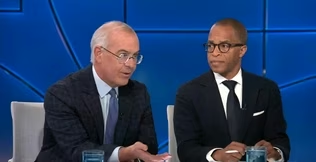
GEOFF BENNETT: From the fallout over a controversial boat strike to growing fractures inside the House GOP, lots to discuss tonight with Brooks and Capehart.
That's New York Times columnist David Brooks and Jonathan Capehart of MS NOW.
Good evening, gentlemen.
It's great to see you both.
JONATHAN CAPEHART: Hey, Geoff.
DAVID BROOKS: Good to see you.
GEOFF BENNETT: So Washington has been consumed this past week with a debate over a series of strikes that killed two survivors of an initial attack on a suspected Venezuelan drug boat back in September.
And, Jonathan, the administration says that strike and others like it are necessary to protect U.S.
interests.
When you look at all that exists in the public realm right now, does that rationale withstand scrutiny?
JONATHAN CAPEHART: No, it doesn't.
It would help if the president and the defense secretary, this administration, would show us the evidence.
You keep saying that these people are drug runners.
So -- and you know who they are.
So tell us.
You keep saying that they are shipping these drugs, that's what's in those boats.
Well, show us.
Show us the evidence.
But we don't have the evidence.
And then the other thing is, those two people who were killed in that second strike, since then, there have been others and there have been survivors.
If this is such a war on drugs to protect the American people, why aren't those survivors in U.S.
federal custody and not repatriated to their countries?
There are so many questions here that go well beyond what we have been talking about this week.
And that's not to diminish the importance of why we're talking about this.
GEOFF BENNETT: And, David, to that point, I mean, is the U.S.
in your view carrying out a counternarcotics mission in the Caribbean?
Or is this a show of force mission?
And does the administration itself seem clear on the difference?
DAVID BROOKS: Well, it's more the latter than the former, but, frankly, to be a little crude, if you remember 2016, Donald Trump and Marco Rubio got in a fight into a presidential debate about who had bigger hands.
This is the direct descendant of that of who's the bigger man.
Somebody's been watching too many Dirty Harry movies or Charles Bronson and "Death Wish," where they blow away the bad guys.
And this is a video image of, we're blowing away the bad guys.
The main source of the drugs comes over land through Mexico.
If they cared about doing the drugs, they would focus on that.
If they cared about doing the drugs, they would not be blowing up the evidence.
They'd be interrogating the guys they caught.
If they cared about doing the drugs, they would try to work with our allies, not -- and not alienate our allies.
And so this to me is just a TV show.
And I think what appalls me most of all about it is what they're posting, both Trump and Hegseth, on social media.
You look at the pictures of Abraham Lincoln at the end of the Civil War.
You look at the pictures of Franklin Roosevelt at the end of World War II.
The burden of sending human beings into battle and causing death and suffering on both sides was something they bore with incredible heaviness.
And Hegseth treats it like it's a video game.
And it's just like a -- it's just morally offensive.
GEOFF BENNETT: We also learned this week that the Pentagon inspector general found that Secretary Hegseth's use of an unsecure messaging app, Signal, during active operations put U.S.
personnel at risk and that Hegseth did not fully cooperate with investigators.
Jonathan, what do you see as the takeaways here?
JONATHAN CAPEHART: It's breathtaking.
If this were a normal administration, one, Pete Hegseth would never be anywhere near the Pentagon.
But let's say Pete Hegseth had gotten in and this had happened.
That person would have been fired.
There would have been multiple hearings on the Hill, not just of the defense secretary, but of all the other Defense Department officials who were on that Signal chain to get to the bottom of this.
I -- and the idea that the secretary didn't participate in this investigation, between Signalgate and video gaming off of the coast of Venezuela, they are stretching the bounds of decency, the bounds of legality, the bounds of our Constitution in ways where -- I mean, I agree with David.
This is offensive on so many levels.
But we have got all those -- the video of Hegseth talking about the fog of war.
I know I'm going back to Venezuela, instead of Signalgate, but there is a rot at the Pentagon.
And the president of the United States does not seem to care.
GEOFF BENNETT: What about that?
I mean, administrations come and go, but the rules that govern secure communications are supposed to endure.
What does it say that the Cabinet secretary, the defense secretary, could disregard those rules with so little apparent consequence?
DAVID BROOKS: Yes, I would love to know if they ever had a conversation after Jeff Goldberg's story came out and where they said, should we just admit that we screwed up?
I think a normal human being would say, yes, we screwed up.
But then I remember Hegseth got off a plane or a helicopter, and instead of saying the obvious, which actually would have earned him a little credibility, given what -- the story he was stuck with, he went after Jeff, and then he didn't cooperate with this investigation.
And when the investigation comes out saying explicitly in black and white that he endangered U.S.
troops, he said, oh, totally exonerated.
And so there's just a history of not only a little lie.
Like, don't -- they didn't bend the truth.
They broke it, stepped on it, burned it, and buried it in the ground.
And so I would love to know if they even have a consciousness, maybe we should tell the truth that we messed up.
GEOFF BENNETT: Yes.
You know, we spend a lot of time on this program looking at the political divide and the toxic discourse fueled by conspiracy theories and misinformation.
And, last night, there was this admission that really caught our attention.
Dan Bongino, who was once this prominent right-wing influencer who trafficked in conspiracy theories, he explained why he pushed those narratives.
And we should explain to our audience he's now the number two official at the FBI.
And he promoted years ago false claims about the January 6 pipe bomb case, even suggesting that it was an inside job.
Here's what he said to Sean Hannity last night.
SEAN HANNITY, FOX News Anchor: You put a post on X right after this happened.
And you said: "There's a massive cover-up because the person that planted those pipe bombs, they don't want you to know who it is because it's either a connected anti-Trump insider or an inside job."
DAN BONGINO, Deputy FBI Director: You know, listen, I was paid in the past, Sean, for my opinions.
That's clear.
And, one day, I will be back in that space.
But that's not what I'm paid for now.
I'm paid to be your deputy director.
And we base investigations on facts.
GEOFF BENNETT: Have you ever heard a clearer admission of the incentives that are warping our political discourse, Bongino saying, yes, I said all that stuff, but I was paid to say it?
JONATHAN CAPEHART: I -- this whole segment is breathtaking.
JONATHAN CAPEHART: The topics that we're talking about.
And I just want to say it's great to have proof of life of Dan Bongino, that he's actually still in the number two job after saying he was going to quit.
The incentive structures are wildly perverse.
So he was paid to spin conspiracy theories.
Now he's being paid to be the number two at the FBI.
Why would any law enforcement agency out in the country, why would any American citizen trust anything that comes out of the FBI,between Director Kash Patel, who was part of all of this, to this guy?
I mean, we are in -- we are in a deep mess being run by a cadre of fools who shouldn't be in the jobs that they're in.
DAVID BROOKS: Before I answer, could you tell me what you're paying me to do?
DAVID BROOKS: Do you want the conspiracies or do you want the truth?
I just... GEOFF BENNETT: Truth.
Nothing but the truth.
DAVID BROOKS: You know, what -- I mean, it is -- it illustrates how much of it is a circus, how much it is a performance.
Well, you see -- I worked with Tucker Carlson for nine years at "The Weekly Standard."
We helped co-found the magazine together.
And I had a wonderful time with Tucker.
But I watched him and I watched other people who have gone on to those kinds of careers get captured by the audience.
The audience, they feel the visceral rise of the audience when they do something edgy and crazy.
And then, once you give them that, the dose has to keep going up and up and up.
And they are just captured by it, and they get charade to wherever the audience wants them to go.
And they become, in Tucker's case - - I don't know Mr.
Bongino.
But he is a different human being than the one I knew.
And I think it is this seductive process of populist sort of drug dealing, basically, intellectual drug dealing.
GEOFF BENNETT: What's to be done about it?
I mean, the suspect in the January 6 pipe bomber case reportedly said that he believed the conspiracy and the false claims that Trump didn't win the election.
There are clear consequences to this misinformation and these conspiracy theories.
JONATHAN CAPEHART: Are there?
We have just seen more than 1,000 people who participated in the riot of the Capitol on January 6, were held accountable in courts of law, only to be pardoned by the president of the United States.
So, at this point, great.
You found the bomber.
Should we start the countdown clock on when that person gets pardoned?
GEOFF BENNETT: David?
DAVID BROOKS: I just think there should be more shame for conspiracy thinking.
If you think January 6 was an inside job, if you think 9/11 was an inside job, you are spreading the kind of acidic disinformation that destroys all our institutions.
And just to ride my hobbyhorse for a little bit, if you think the FBI and Joe Biden's Justice Department were hiding some massive conspiracy about Jeffrey Epstein, you are defaming the men and women of the FBI and the DOJ.
And it's an attempt at dehumanization.
And people spin these conspiracy theories, and so I'm just -- questions are being asked.
It's all dishonorable inference.
But it has clear corrosive effects on democracy that, if we can't trust the institutions of our government, then we do not have a democracy.
And conspiracy thinking is a kind of acidic kind of mental disease that undermines that.
GEOFF BENNETT: Indeed.
David Brooks, Jonathan Capehart.
my thanks to you both.
JONATHAN CAPEHART: Thanks, Geoff.
DAVID BROOKS: Thank you.
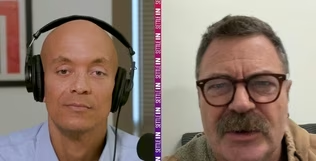
GEOFF BENNETT: We turn now to our video podcast "Settle In."
In our latest episode, I speak with actor Nick Offerman, who joined me on a video call during a break on set.
Since playing the curmudgeonly Libertarian Ron Swanson on NBC's "Parks and Rec," he's avoided being typecast, most recently portraying President Chester Arthur in Netflix's "Death By Lightning."
We spoke about that role in his latest book, "Little Woodchucks."
It's a guide to woodworking for kids and much more.
Here's some of that conversation.
So this book, it is such a joyful, mischievous guide to working with your hands.
What made you come up with this idea to write a woodworking book specifically for kids, but also their parents who might be learning alongside them?
NICK OFFERMAN, Author, "Little Woodchucks: Offerman Woodshop's Guide to Tools and Tomfoolery": Well, I have had my woodshop for 20-plus years, and I ran the shop with my co-author, whose name is Lee Buchanan.
And before -- I mean, we both came from families where we were taught to use tools and make things, whether it was sew buttons on our clothing or make things in the kitchen or make things with tools in the shop.
And it just made our lives better.
And so over the years, we talked about different ideas for passing along this knowledge to families, because it's funny.
The book is designed for families to learn to make things together, but it's kind of a gentle way of saying, hey, parents, you can teach your kids to use tools, but also I know a lot of you also don't know how to use tools.
So this is a really fun way to put people's phones and iPads down and spend time together improving their lives without using any algorithms, just with a hammer and a pair of pliers and a good time.
GEOFF BENNETT: Well, that's one of the things I love about the book, is that these projects, when you show the finished result, they look as if the kids actually made them, as opposed to -- no disrespect to set designers, but a set designer making them and saying, here kid, hold this.
But before you found success as an actor, you spent years building sets, sanding floors, taking odd jobs.
What did those lean years teach you about perseverance?
NICK OFFERMAN: Well, my mom and dad are incredible citizens.
They raised four really -- four kids with good values and a great work ethic.
And so going into the arts is a risky proposition.
And I said, I want to go to theater school.
I want to try and be an actor.
And they said, well, we support you because you have a good work ethic, but try and have something to fall back on so that you can make a living in case you don't get cast on "Parks and Rec" until you're 38 years old.
Have some -- have another way to feed yourself.
And I already had these tool skills that I grew up with.
And so I became a carpenter, started framing houses, and then I ended up building a lot of scenery, as you pointed out.
I mean, there were years in my 20s when I thought that that might be my life.
I was like, well, I'm not really getting cast in plays the way I want to, but I really love building scenery.
And so if I ended up just being a scenic carpenter in Chicago for my career, that would have been a pretty wonderful theater community to work in.
And I would have been very happy.
So I have always been so grateful that I have had -- that I have those skills while I'm waiting for the next script to come in.
GEOFF BENNETT: I want to ask you about this new Netflix series, "Death By Lightning."
You play President Chester Arthur, a figure that I would think it's fair to say most Americans know little about.
What drew you to that role?
NICK OFFERMAN: Well, first of all, I think that's a spoiler alert to say President Chester Arthur.
(LAUGHTER) GEOFF BENNETT: It's true.
NICK OFFERMAN: And, hilariously, most of the audience doesn't -- won't actually know.
They have probably heard the name Chester Arthur.
But the incredible thing about how that series came to be, our wonderful writer, Mike Makowsky, read the book "Destiny of the Republic" by Candice Millard, who's a historian whose books I happened to love already.
She has a wonderful book about Teddy Roosevelt, a great Winston Churchill book.
And so Makowsky read the book and just said, holy cow, this story is incredible, and nobody knows it.
I mean, reading the script and especially learning about the journey, the sort of -- the crazy roller-coaster arc that Chester A. Arthur goes through in his journey, becoming vice president and then, spoiler alert, ultimately president, just blew me away.
I was so excited to hopefully inspire the audience.
I mean, it's such a lush production.
Matt Ross beautifully directed it.
Benioff and Weiss and Bernie Caulfield produced it.
They also made a little show called "Game of Thrones."
And this felt as lush.
Like, they lavished so much attention on the beautiful -- the sets and the costumes.
And the cast is so astonishing.
I just love the idea of inspiring our American audience to the idea that we can actually get past the corruption in politics and we -- it's -- that we have the power to choose somebody with integrity.
It's crazy that that would be a novel idea, but it's certainly one we seem to have gotten away from.
GEOFF BENNETT: And you can hear and watch full episodes of "Settle In" on YouTube, Spotify, Apple Podcasts or wherever you get your podcasts.
And we will be back shortly, but, first, take a moment to hear from your local PBS station.
It's a chance to offer your support, which helps to keep programs like the "News Hour" on the air.
For those of you staying with us, earlier this year, New York's Metropolitan Museum of Art opened its newly renovated galleries of the Arts of Oceania.
In the exhibit, curators reimagined how to present art from the vast region, which includes the more than 10,000 Pacific islands in Melanesia, Polynesia and Micronesia, as well as Australia and New Zealand.
Senior arts correspondent Jeffrey Brown toured the galleries for our arts and culture series, Canvas.
JEFFREY BROWN: This is grand, imposing.
MAIA NUKU, Curator, The Metropolitan Museum of Art: This is the Kwoma ceiling.
JEFFREY BROWN: Soaring above one of the Met's new Galleries of Oceania, one of the museum's most iconic artworks from the Pacific.
Made by artists from the Kwoma people of Northeast Papua New Guinea, the installation represents the ceiling of a men's ceremonial house, typically the largest and most sacred building in a Kwoma village.
Each individual panel is infused with meaning, painted with symbols associated with different village clans, says curator Maia Nuku, who spoke to us even as final touches for the reopening were being completed.
MAIA NUKU: You have got a fabulous set of crocodile eyes there in this gray one with the yellow eyes in pairs coming down.
JEFFREY BROWN: And then you put it together and it becomes the universe.
MAIA NUKU: From a Kwoma perspective.
That's right, yes.
JEFFREY BROWN: Yes.
Originally commissioned in the early 1970s, it's now been rearranged according to the wishes of the descendants of the original artists to accurately reflect clan groupings.
MAIA NUKU: They had a lot of input into how we reconfigured this new iteration.
It's critical for them to be able to have a say in how they're represented.
JEFFREY BROWN: It's just one example of how the museum has rethought and recontextualized its installation of more than 600 artworks from across the Pacific.
MAIA NUKU: I think go out and view it.
JEFFREY BROWN: Nuku, a member of New Zealand's native Maori community and the Met's first indigenous curator from Oceania led the effort.
I use the word reimagining these galleries.
What word do you use?
MAIA NUKU: Yes, recalibrating.
We are reimagining the collections for the 21st century.
JEFFREY BROWN: It's the first time the Oceania collection will have its own dedicated space, part of a broader multiyear $70 million renovation of the Met's Michael C. Rockefeller Wing.
Museum director Max Hollein: MAX HOLLEIN, CEO and Director, The Metropolitan Museum of Art: I think that we now have reached a point where we not only have a much deeper knowledge about these works of art, but also a much deeper understanding about how to present them, how to show them to make a really truly meaningful installation.
JEFFREY BROWN: The wing centers around a collection of non-Western fine art amassed by the philanthropist and statesman Nelson Rockefeller in the 1950s and '60s.
It's named after his son Michael, who disappeared on a collecting trip to New Guinea in 1961.
His story is featured in a video in the galleries, alongside many of the works he collected, like these intricately carved beast poles made for funeral feasts by Asmat artists in Southwest New Guinea.
MAIA NUKU: He was very invested in recording the names of artists.
So for this Asmat collection, we have the names of the artists, sculptures and even some of the commissioning chiefs.
So really they're not anonymous craftsmen from the past.
They are master carvers, they are master weavers, and they have names and biographies and they are really revered in the culture.
MAX HOLLEIN: I think people go sometimes through these galleries and think that these are all works from way back, as if it's antiquity.
This is the art of the last century.
It has a deep impact also on other cultures and traditions.
And that's something that's coming really to the fore here.
A big challenge in the reimagining, the Met-specific works represent some 140 distinct cultures from a region covering almost a third of the world's surface.
MAIA NUKU: Art from Oceania is really very unfamiliar to many people.
And so what I was really interested in doing with this new re-display was to have people understand the relationships, the line that's pulling all of these cultures through over this vast kind of sphere of space and time.
JEFFREY BROWN: Those relationships stretch back at least 3,500 years, when seafaring voyagers made their way from modern-day Taiwan through Southeast Asia.
Then, after intermingling with indigenous peoples in New Guinea, they set out on vast journeys to settle on islands across the Pacific Ocean.
Voyaging both literal and spiritual is a key theme in the galleries, which include items like this spirit canoe used by Asmat people to commemorate the recently dead.
The common ancestry of diverse island communities is highlighted through repeating forms and motifs, like the frigate bird.
MAIA NUKU: The frigate bird is really a piratical bird.
It's really revered right across the Pacific.
It has a huge wingspan and it can actually take food out of the mouths of other birds.
again atop a mask from the Torres Strait Islands.
Another key theme, this is living contemporary art, now represented with new acquisitions like this work by Taloi Havini, who was born on the island of Bougainville.
TALOI HAVINI, Artist: It was quite an honor to be asked to contribute something as a contemporary artist.
It sort of shows that we're here, we're proud, and we have artworks that deserve to be seen in the global context of art.
The designs that I have integrated into the materiality of my work really speak to my ancestors' designs about care and protection, about the things that we hold precious to us.
JEFFREY BROWN: Those designs are rendered on copper, referencing the copper mine in her region that led to a civil war.
TALOI HAVINI: This might not look traditional because I have used the materiality that speaks very much to appropriation and extraction because I'm using copper, and yet when I show my community the work, there's no question that it comes from and is an artwork.
JEFFREY BROWN: Like Havini's work, curator Maia Nuku hopes the new galleries reflect living traditions that can speak to all people today.
MAIA NUKU: The fact that we are just one stitch in this genealogical fabric that stretches over millennia, and the planet, the land, the seas are not ours.
We're stewards of them for this generation.
JEFFREY BROWN: For the "PBS News Hour," I'm Jeffrey Brown at the Metropolitan Museum of Art in New York.
GEOFF BENNETT: And there is a lot more online, including a closer look at the buy now/pay later microloans people are using to fund their holiday shopping.
That's on our YouTube page.
Be sure to tune into "Washington Week With The Atlantic" later tonight here on PBS.
Jeffrey Goldberg in his panel discuss Secretary Hegseth's week playing defense and the fallout from Signalgate.
And watch "PBS News Weekend" tomorrow for a look at how A.I.
is being used to help predict preterm births.
And that is the "News Hour" for tonight and for this week.
I'm Geoff Bennett.
For all of us here at the "PBS News Hour," thanks for spending part of our -- part of your evening with us.
Have a great weekend.
Brooks and Capehart on fallout over Trump's boat strikes
Video has Closed Captions
Clip: 12/5/2025 | 10m 25s | Brooks and Capehart on the political fallout over Trump's boat strikes (10m 25s)
CDC panel drops hepatitis B vaccine at birth recommendation
Video has Closed Captions
Clip: 12/5/2025 | 7m 29s | RFK-appointed CDC panel drops hepatitis B vaccine at birth recommendation (7m 29s)
News Wrap: Supreme Court to hear birthright citizenship case
Video has Closed Captions
Clip: 12/5/2025 | 6m 36s | News Wrap: Supreme Court to hear case on Trump’s order ending birthright citizenship (6m 36s)
Nick Offerman joins Geoff Bennett on our ‘Settle In’ podcast
Video has Closed Captions
Clip: 12/5/2025 | 5m 46s | Nick Offerman joins Geoff Bennett for our ‘Settle In’ podcast (5m 46s)

Trump’s threats raise fears in Minnesota’s Somali community
Video has Closed Captions
Clip: 12/5/2025 | 7m 9s | Fraud scandals and Trump’s rhetoric escalate fears in Minnesota’s Somali community (7m 9s)
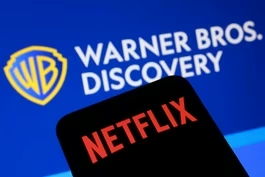
What Netflix's deal to buy Warner Bros. means for Hollywood
Video has Closed Captions
Clip: 12/5/2025 | 6m 39s | What Netflix's deal to buy Warner Bros. means for one of Hollywood's oldest studios (6m 39s)
Providing Support for PBS.org
Learn Moreabout PBS online sponsorship
- News and Public Affairs

FRONTLINE is investigative journalism that questions, explains and changes our world.

- News and Public Affairs

Today's top journalists discuss Washington's current political events and public affairs.









Support for PBS provided by:
Major corporate funding for the PBS News Hour is provided by BDO, BNSF, Consumer Cellular, American Cruise Lines, and Raymond James. Funding for the PBS NewsHour Weekend is provided by...