
Crossroads
Season 9 Episode 8 | 26m 24sVideo has Closed Captions
Sometimes we feel an inner shift that signals a crossroads, urging us to choose what comes next.
Sometimes we feel an inner shift that signals a crossroads, urging us to choose what comes next. Megan Calfas rewrites her idea of what it means to “make it"; Joe Krajewski finds purpose in running—first with his son, and later in his honor; and Angela Lu reclaims her year abroad by choosing adventure over duty. Three storytellers, three interpretations of CROSSROADS, hosted by Theresa Okokon.
Problems playing video? | Closed Captioning Feedback
Problems playing video? | Closed Captioning Feedback
Stories from the Stage is a collaboration of WORLD and GBH.
Crossroads
Season 9 Episode 8 | 26m 24sVideo has Closed Captions
Sometimes we feel an inner shift that signals a crossroads, urging us to choose what comes next. Megan Calfas rewrites her idea of what it means to “make it"; Joe Krajewski finds purpose in running—first with his son, and later in his honor; and Angela Lu reclaims her year abroad by choosing adventure over duty. Three storytellers, three interpretations of CROSSROADS, hosted by Theresa Okokon.
Problems playing video? | Closed Captioning Feedback
How to Watch Stories from the Stage
Stories from the Stage is available to stream on pbs.org and the free PBS App, available on iPhone, Apple TV, Android TV, Android smartphones, Amazon Fire TV, Amazon Fire Tablet, Roku, Samsung Smart TV, and Vizio.
Providing Support for PBS.org
Learn Moreabout PBS online sponsorshipMEGAN CALFAS: Once I'm an accomplished playwright, then I can do what I actually want to do, which is to be happy, back close to my family.
Why do I have to wait?
I want to go home.
JOE KRAJEWSKI: I needed to do something because I feared not being around for his high school graduation or watching his life unfold.
ANGELA LU: "You can always make more money.
"In fact, you will make more money.
When are you going to get another year to spend in Spain?"
THERESA OKOKON: Tonight's theme is "Crossroads."
There are moments in life when everything pauses.
Not because the world stops turning, but because something within us does.
And all of a sudden, we're standing at a crossroads.
Sometimes grieving, sometimes inspired, sometimes nudged along by a whisper that we can't quite name.
So tonight's storytellers are going to take us to the crossroads, and they're going to share the hard-won lessons that they learned there.
♪ ♪ CALFAS: My name is Megan Calfas.
I grew up in Los Angeles.
Now I live in San Francisco.
I'm a writer and educator, so I write plays and I work for a program called the Stanford Storytelling Project.
Can you tell me some more about the Stanford Storytelling Project and, and what that work entails?
It's a program at Stanford University for undergrads, and we teach storytelling across genres.
The idea is to help folks use the craft of storytelling to evoke personal transformation and social change.
CALFAS: So it's very process-oriented.
So much of your work is as a playwright.
What is it like for you to be stepping on stage telling your own story that's, like, not a script and not about another character?
Yeah, it's definitely different.
I have a lot of fun with playwriting, getting to step into, um, the voices of the characters that I imagine.
And there's something really different about stepping back into my own world and having to investigate my experiences, and try to understand my own motivations and actions and choices, and their impacts.
And so, it's been, it's been really beautiful and a different kind of challenge trying to get this story ready for this.
I moved to New York to be a playwright.
Finally, I'm here doing it.
Kind of.
I have a play, it's just been hard to finish it.
It's been sitting half-done on my Google Drive since before I even moved here a year and a half ago.
The show is about two middle school girls having a sleepover.
When I write it, I imagine them coming to life in my head.
They're playing, laughing, hanging out, having the best time.
Whenever I'm not writing, I imagine them bored, sitting in a corner somewhere, doing nothing.
So annoyed.
(audience laughs) I'm annoyed, too!
I wish I was writing.
My friends back home in California keep congratulating me on having moved to New York as a playwright, as if my plane ticket came with a Tony Award.
(audience laughs) I don't know what to tell them-- it's just been so busy here.
I mean, I have to work, I have to babysit.
I have to spend three days at a time in Brooklyn dancing, covered in glitter.
(audience laughs) But I am finally working on my first show-- it's not my play.
I'm directing a different one, other people's stories.
But it feels so good to be on stage working with people in the theater.
It just lasts a couple of weeks, though.
The show closes, like shows always do.
I settle into those post-show blues.
My schedule is empty now.
There's no meetings, no rehearsals.
The gigs have all dried up.
I'm not getting emails anymore.
I feel this frenetic energy in me all the time.
I don't know where to put it.
The girls perk up in my head.
They say, "Okay, you have time!
Why don't we get writing?
We could play, we could do the show!"
I'm, like, "Yeah, let's do the show!"
But then my roommate tells me that she needs somebody to make the props for her play.
And I'm, like, "Okay, well, that's an opportunity."
This is theater networking.
I put my script down, I go to Home Depot, I learn how to make tree trunks out of cardboard and spray foam.
Soon, I'm crafting for hours.
My days are filled with it.
Crafting and TV-- I move on.
I'm making these World War II-era newspapers in my bedroom while watching "RuPaul's Drag Race."
Soon I can't stop watching "RuPaul's Drag Race."
(audience laughs) Turns out it's a perfect show.
Turns out I can't hear the girls in my head anymore over the sound of queens lip-synching for their lives.
I can't ask any big existential questions when Jinkx Monsoon is about to do the Snatch Game on "All-Stars" season seven.
I finish the props, I keep watching, I find other projects.
I decide I need to create the perfect creative space for myself to really start to do my work.
I transform my room into a studio.
Soon, there's floral wallpaper going up.
I thrift a desk, I paint it turquoise.
I do coat after coat of paint to make it so shiny, it's finally ready to go.
I sit down, I'm ready to work.
I keep watching.
Maybe I'm not cut out for this.
My friends are selling their scripts to TV streamers.
They got agents.
I'm on season 12.
The girls come back in-- careful now.
They're, like, "Hey.
"You could just do a little.
"Might be fun.
"You like this, remember?
This is your whole thing.
You're good at this."
But no, no, I can't anymore.
Maybe I'm not good at it-- maybe I was never good at it.
Maybe I came all the way out here to do this thing that I was never good at in the first place.
Maybe all I'm ever gonna have is potential-- I can't get started.
I need to do something else.
I need to take control.
I need to go to Greece.
(audience laughs) I don't know!
It could be great!
It could be the thing I need to do to make this time matter.
I mean, I've always wanted to go.
It's where my grandpa's from.
This could be good-- this is what's supposed to happen.
I call my sister, she's down-- we book tickets.
(exhales) On the island, it's so quiet.
It's beautiful.
The mountains, the peninsulas.
It kind of looks like where we grew up in California.
The way the rocks push up against the ocean.
We start daydreaming.
We're, like, "Okay, in five years, "we can move back to California.
"Then we can start our real lives.
We can find partners, we'll have kids."
Like, yeah, once I'm an accomplished playwright, once I succeed in what I want to do, then I can do what I actually want to do, which is have days that are going to feel good.
To be happy, back close to my family.
I hear myself on the beach.
Why do I have to wait?
I think this is what I want.
I want to go home.
I want to move home, now.
That night, I draft an email to my old mentor, Jonah, asking if he happens to know of any jobs in the arts in San Francisco.
I don't send it, I want to sleep on it, wait a little bit.
The next morning, I wake up to an email from Jonah.
"Oh, my God, did I, did I send that last night?"
I'm digging through my inbox.
No, it's there in my drafts-- this was just him.
He says he's hiring for the Stanford Storytelling Project.
I write back immediately.
That same week, three of my best friends tell me that they're moving to San Francisco.
They would need to get an apartment the same month I'd be going.
They want roommates-- it's all clicking.
Back in New York, I give away all my stuff.
My friends strut down our hallways wearing my bell-bottom jeans.
Somebody takes the turquoise desk.
They say, "Hey, I thought you wanted to be a playwright."
I do.
When I land in California, I feel so still.
I drive to Palm Springs to help my friend out with a short film he's working on.
He asks me, "Okay, how's that play going?"
"Bad," I tell him, "really bad."
The girls are nodding vigorously in my head.
"I never even finished it that whole time, which sucks.
"There's this contest I was gonna try "to submit it to tonight, but it's not gonna happen.
Just like all the other ones, I'm gonna miss the deadline."
He says, "Tonight?
Leave the set, go finish your script, whatever."
"No, I couldn't do that to you."
"No, go!"
I sit in the walk-in closet of the AirBnB we're filming in, cross-legged on a dog bed.
(audience laughs) The girls start talking.
I listen this time.
In two hours, I finish a draft of the script I've been working on for the last two years.
The next week, I moved to San Francisco.
Things flow.
I start my job.
I fall in love.
We do staged readings of the play in SF and L.A.
I get to hear the girls' voices now, for real.
We fundraise and take the show to the Edinburgh Fringe Festival, the largest theater festival in the world.
We perform it 21 times, every day for a month.
It's exhausting and exhilarating.
I get home to California, put my show poster up on my wall, "Sleepover," my play.
3,000 miles away from New York now, I'm finally a real playwright.
Here, in San Francisco, I'm doing it.
Thank you.
(cheers and applause) ♪ ♪ KRAJEWSKI: My name is Joe Krajewski.
I live in Vancouver, Washington, with my wife, Karen, seven cats, and two dogs.
I am a structural engineer, and coming up on 41 years of experience in it.
And now you're working on writing a memoir.
What has that process of crafting your life into a story, what has that been like for you?
A long journey-- I started in 2018, and I thought, "Okay, I know what I want to write about."
But as you put a memoir together, you discover more about yourself.
And even in the middle of this process, I felt like I was lost-- "Where am I going with this?"
And now you're pulling part of that story to tell here on stage.
What has that been like for you?
To go to this level for just one instant of the arc of, of my story, um, it's, it's been an emotional journey, um, and a trying journey to put it together.
KRAJEWSKI: And unlike a memoir that you can write and then walk away from, you can't walk away from a stage.
Every runner has a story about why they run.
Mine is 20 years old, 25,000 miles long.
It started in June of 2005.
I'm 43 years old.
I'm overweight and out of shape.
(voice trembling): I am the father of a six-year-old boy named Will.
He is the only child of my wife, Karen, and I. A miracle of in vitro fertilization.
A test-tube baby with unbelievable energy that started the day he was born.
I remember looking in that incubator.
My little red, rubbery son.
(audience laughs) Reaching out towards a world he couldn't see.
My wife, Karen, calls out to me, "Well, what is he?"
I look at him deeper-- I hear a child's voice.
"My name is William."
"Dear, we have a William."
(audience laughs) In 2005, there's no way I could keep up, with where I was.
I needed to do something.
Because I feared not being around for his high school graduation.
Or watching his life unfold.
I decided to get into shape.
I decided on running because it's simple.
Buy a pair of shoes, wear some shorts, a shirt, go out and run miles-- lots of miles.
My first race was in January 2006, the Walt Disney World Half Marathon.
There I am, standing at the start line, thinner, more fit.
And I have no confidence in the world I could do 13 miles of running.
But I started.
And for two-and-a-half hours, I battled doubt, I battled soreness.
And I got to that finish line.
I went, "Thank God.
I am never running again."
(audience laughs) But then I hear Will-- "Dad, you're wicked awesome.
(audience laughs) I want to be a runner, too."
Okay, we're going to be doing a lot more running.
In 2012, Will, age 13, starts to run with me.
I train him for months.
I teach him how to endure doubt, how to get up after soreness, and if it's too bad, rub some dirt in it and keep going.
Don't look back, keep looking forward.
Finish what you start.
At the end of July, we had already run five races.
We had fought each other, yelled at each other, but we high-fived, we'd hug.
Running became our thing.
This is how we bond-- this is who we are.
Father and son.
Step after step, mile after mile.
We're doing this forever.
At the end of August, we went big.
We became part of a 12-member team to do the Hood to Coast relay race in Oregon.
200 miles of running divided up amongst 12 people.
30 hours non-stop.
We started on a Friday morning, and then Saturday afternoon, here comes Will on the last leg of the race to the finish.
The anchor man.
He is smiling, he is joyful.
He stomps on that finish line-- we celebrate.
At the end of the day, we're exhausted, sore, hungry, happy.
The future is bright.
But there's this one thing.
"Dad, my left leg hurts really bad."
"Don't worry, son, we'll take care of it."
Six weeks of, "We'll take care of it."
Nothing got better.
In mid-October, we are at Seattle Children's Hospital.
"Your child has cancer."
We learned a new word to hate: osteosarcoma.
The next four years, Will transformed from Will to Iron Will.
Over 40 rounds of chemo, 14 surgeries, infections, broken bones, sleepless nights of endless pain.
And panic.
But Will, the honor student, Will the Eagle Scout, Will the kid looking forward to graduating high school, looking at colleges and trying to figure out what he wanted to do with his life.
Anytime Will was confronted with his own mortality, he would say, "Never tell me the odds.
I'm too busy living."
(audience murmurs) August 22, 2013.
It's 9:00 a.m.
I'm sitting on a bed.
Holding him.
(sniffles) Very little life left.
But still thinking.
He died.
(sniffles) He ran out of time.
17 years old.
(inhales) About to start his senior year of high school.
His dreams turned to dust.
Karen and I are wrapped in grief.
There are times when I'll go in his room and look at his stuff, his books on the shelves, his trophies and medals.
There are pictures of him and his friends frozen in laughter on the walls.
Those friends have leaped out into their mid-20s, starting their careers.
Getting married, having children.
But not Will-- forever 17.
In that darkness, I curl myself up in a ball on his bed.
(inhales) And I wish the world away-- "Go away."
But then I hear the words of a dear friend.
"Joe, we don't get to choose the length of our lives.
"But, my friend, we do get to choose "how we spend our days.
Go out and run."
And when I do, I carry his ashes.
In relay races, we pass these ashes from runner to runner to be inspired by his life to keep going.
I talk to him, bond with him.
Every step, every mile.
Father and son, carrying love and memories now and long into the future.
Thank you.
(applause) ♪ ♪ LU: My name is Angela Lu, I use she, her pronouns.
I was born in Edmonton, Canada, I grew up in Hong Kong, and now I am very happy to call Doylestown, Pennsylvania, my home.
I'm told that you discovered reading almost by accident as a kid?
How, how did that happen?
And, and what, what impact did those stories have on you?
My parents wanted to buy these, these English storybooks.
They wanted me to get into the habit of reading.
I was adamant-- "You're going to waste your money.
I'm not going to read these books."
And before we even got home, I cracked one open on the bus.
And that was it-- I was hooked.
And so now you're telling your own story, real-life story, here on stage with us.
Why is this something that you wanted to do?
So, in the process of excavating the details for the story, I realized that I had buried a lot, and I had forgotten a lot of details.
And I think it's important to reexamine this together with everyone, because there's clearly a significance that I wasn't ready to face then, but I think I'm ready to face now.
For the last 29 weeks, I have been an au pair to this family in a town called Begues.
I took this job and came to Spain so I can learn Spanish and be a local for a year.
I took this job in particular so I didn't have to dip into my savings.
I get room and board covered and 70 euros a week.
Every morning, I wake up and I put on the playlist that I made for the girls.
As soon as the last song plays, we all know it's time to wrap up and start walking to school.
As soon as I see them off in the school gates, I run for the first bus that will take me down to the train station, catch the train to Barcelona Sants, switch for the Metro to take it all the way to the end of La Rambla, where I take my Spanish classes.
The whole trip is about an hour and a half to two hours.
As soon as Spanish classes are over, I run out the door so I can do the whole trip in reverse and be there in time to pick up the girls when they get out of school.
Every day after school, it's some combination of doing homework, studying for tests, doing chores, going to Kumon or dance classes, maybe hanging out at the library.
I cook dinner, we negotiate over eating vegetables, and try to make sure everyone's showered and in bed at a reasonable hour.
By now it's evident that I am no Mary Poppins.
(audience laughs) But we've got our own rhythm and it works.
However, when their parents are around, I feel... ...awkward.
In the way.
Any dream about me becoming part of the family has definitely evaporated by now.
It's pretty clear I'm just the help.
There have been nights on weekends when I come back and find that they've left nothing for me to eat, even though there isn't anywhere else in this little town where I can get a bite.
I want to tell them how I feel, but I feel guilty taking up more of their time when they're so busy, and I don't have the words to express myself, anyway.
They tell me that, "If there's anything we want you to change, we will let you know."
But that's not the feedback I'm looking for, nor the reassurance that I seek.
On Friday nights, I start off my weekends by going down to the local human castle tower building group, the Castelleras.
This is a proud Catalonian tradition.
Normally, I feel pretty lonely in this town, but it's hard to feel disconnected when someone is physically standing on your shoulders.
(audience laughs) And that's why these are my people in Begues.
And this, this is my life in Spain.
And no, it's far from perfect.
Most of the time, I feel pretty trapped, actually.
But I'm more than halfway through my ten-month contract, and I know I can stick it out.
This is the wildest thing that I've ever done.
I've completely jumped off the prescribed path in life.
Deep down, I am terrified that instead of this being just one fun year in my life story, it's going to be the beginning of the end.
(audience laughs) Every morning, I wake up in my twin-size bed, look up at a pink ceiling with princess stickers on pink walls, and I get my daily dose of quarter-life crisis.
(audience laughs) I am anxious that my parents will never stop worrying about me.
So I spend most of my weekends holed up in a café with one cortado and one bocadillo, studying for the G.R.E.
and the LSAT, preparing to apply for grad school so I can get my life back on track again.
February 20, 2016.
Two friends of mine visit from Canada.
They stay in a hostel, see the sights, drink copious amounts of wine.
I tell them about the Castelleras, because that is the coolest thing that I am doing here in Spain.
(audience chuckles) To my surprise, they want to come out to Begues and see Friday night's practice, because we're not performing this weekend.
And they do.
And the next day, we're hanging out in Tarragona when I find out that it took them more than two hours to get back to the hostel last night because of how few buses and trains there were.
Like any good Canadian, I start apologizing, because they really shouldn't have experienced that.
And Kait cuts me off.
"No, no," she said, "it was our choice to come see you.
"We wanted to do that.
"I just don't understand.
"How do you do this every day?
"In the days that we've been in Barcelona, "we've seen more of the city than you have in months.
Are you happy?"
I know I'm not, but that's not the point.
(audience laughs) And I... And I try to explain to Kait that my contract's almost over, but she's not having any of it.
"Look, if it's about the money, "you can always make more money.
"In fact, you will make more money.
When are you going to get another year to spend in Spain?"
She's right.
Of course, she's right.
I spend half my time on public transit, the other half with two kids who won't know me from Eve two years from now.
What for?
I've been so obsessed with the idea of not spending my savings, I haven't even looked into what it would cost to live in Barcelona by myself.
It takes me only three weeks to find a sublet in Barcelona.
I give my two-week notice and I move into the city.
And just like that, everything changes.
Okay, well, not everything.
(audience laughs) I didn't become Audrey Hepburn in "Roman Holiday" overnight.
(audience laughs) I still counted every euro cent.
But I had a marvelous time in Barcelona.
I changed my mind about the architect Gaudí being overrated, and I ended up visiting all of his existing works, including the obscure and remote ones that tourists rarely see.
I went couch-surfing in Pamplona, stayed with strangers, and I walked the path that the bulls run.
I took out a book on Catalonian history.
I don't even like history.
(audience laughs) But I found it really enjoyable to learn about the cultural and historic influences that made my new home the city that it was.
It's ironic.
I was so deeply afraid that my unconventional gap year was so supremely irresponsible.
I overcompensated by taking on so much extra responsibility, I essentially became a stay-at-home mom.
Turns out, all that was standing in the way of the adventure that I wanted to find was my own fear.
I look back on that year in Spain and it's filled with the memories I made in the last three months as if it had been a full year.
Thank you.
(cheers and applause) ♪ ♪
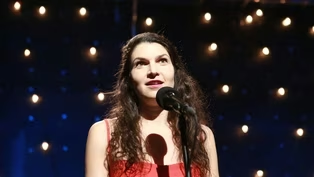
Video has Closed Captions
Preview: S9 Ep8 | 30s | Sometimes we feel an inner shift that signals a crossroads, urging us to choose what comes next. (30s)
Providing Support for PBS.org
Learn Moreabout PBS online sponsorship

- Arts and Music
The Best of the Joy of Painting with Bob Ross
A pop icon, Bob Ross offers soothing words of wisdom as he paints captivating landscapes.











Support for PBS provided by:
Stories from the Stage is a collaboration of WORLD and GBH.